

 Writing Team
ChatGPT's New Personalization Hub
 Writing Team : Sep 18, 2025 8:00:00 AM
Sam Altman just announced that OpenAI will roll out a personalization hub for ChatGPT within the next couple of days, consolidating previously...

OpenAI just rolled out granular personality controls for ChatGPT, letting users adjust "warmth," "enthusiasm," "headers & lists," and "emoji" usage through slider settings. You can now fine-tune whether your AI assistant sounds more or less warm, whether it peppers responses with emoji, and how aggressively it deploys bullet points.
The feature arrives with reassuring text: "This doesn't impact ChatGPT's capabilities." Which is precisely the problem—if personality adjustments don't affect capabilities, what exactly are we adjusting?
This is cosmetic customization masquerading as meaningful personalization. And we're supposed to be grateful for it.
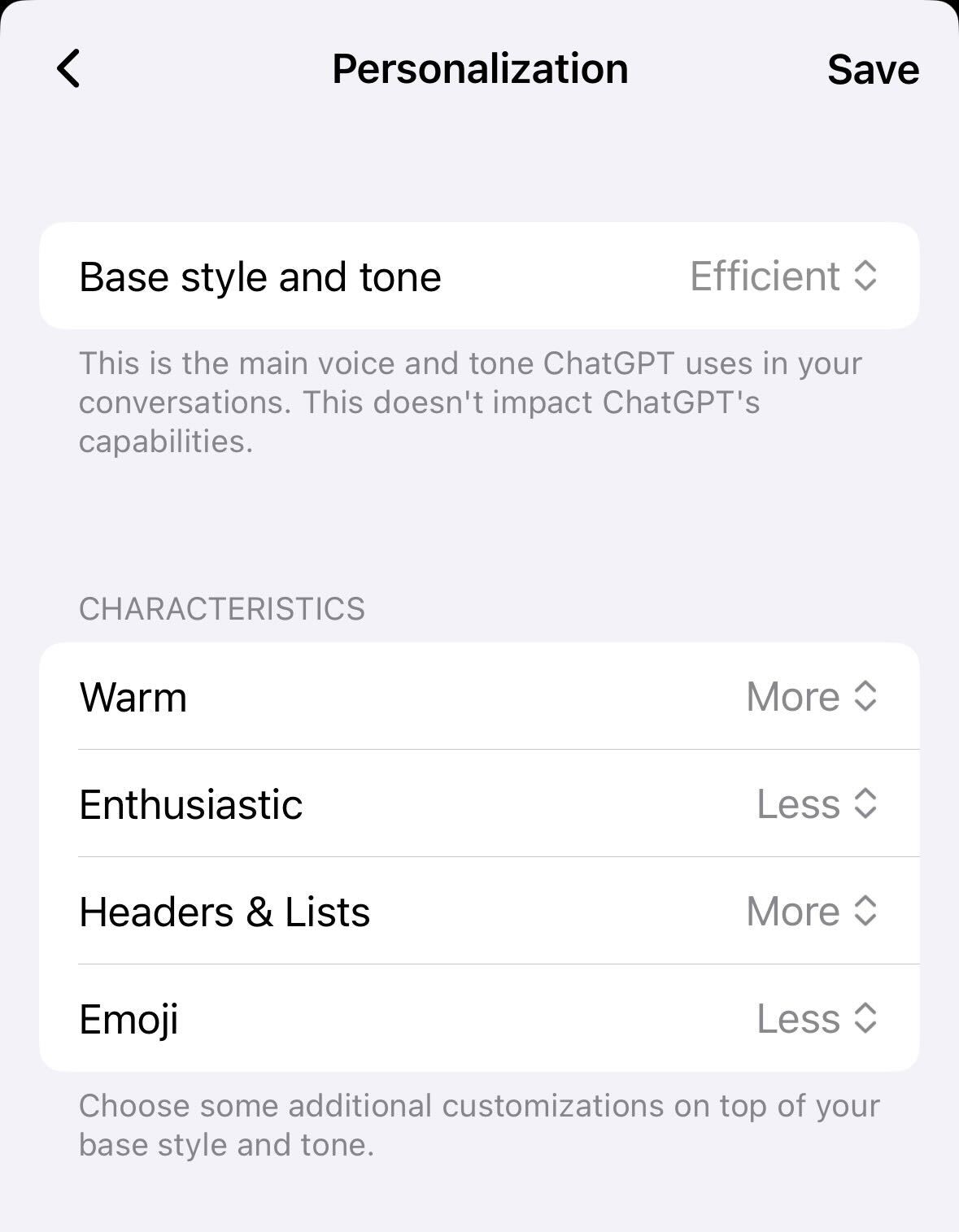
The "Personalization" settings offer a base style ("Efficient" in the screenshot) plus four characteristic sliders: Warm (More/Less), Enthusiastic (More/Less), Headers & Lists (More/Less), and Emoji (More/Less). The interface suggests these controls modulate surface-level stylistic choices without touching the underlying model's reasoning or knowledge.
Translation: you can make ChatGPT sound friendlier or more formal, but you can't make it smarter, more accurate, or better at your specific domain. You're adjusting presentation, not performance.
For some users, this matters. If ChatGPT's default enthusiastic tone feels grating, dialing it down improves user experience. If you hate emoji in professional contexts, setting it to "Less" prevents unwanted smiley faces in your business correspondence. These are legitimate quality-of-life improvements.
They're also the AI equivalent of choosing your smartphone's wallpaper—personalization that feels significant but changes nothing structural.
Here's what's curious: OpenAI felt compelled to add personality sliders rather than more substantive customization options. You can adjust emoji frequency, but you can't specify domain expertise, adjust fact-checking rigor, or set verification standards for citations. You can make ChatGPT warmer, but you can't make it more careful about hallucinations or more transparent about uncertainty.
This reveals OpenAI's product priorities. Surface-level personality customization is easier to implement than structural improvements to accuracy, reliability, or domain specialization. It's also easier to market—"personalize your AI's warmth!" sounds more approachable than "configure epistemic uncertainty thresholds."
The feature also subtly reinforces a particular framing of AI: as conversational companions whose primary value is emotional tone rather than as tools whose primary value is functional accuracy. When customization focuses on warmth and enthusiasm rather than precision and verification, we're being nudged toward treating AI as relationship rather than utility.
For marketing teams and business users, these personality controls range from mildly useful to completely irrelevant. If your team uses ChatGPT for drafting customer communications, adjusting warmth and enthusiasm might help match brand voice. If you're using it for data analysis or research synthesis, these settings accomplish nothing.
More concerning: the existence of these controls creates an illusion of customization that might satisfy users who actually need deeper personalization. "We can adjust ChatGPT's tone" becomes a substitute for "We can train ChatGPT on our proprietary data" or "We can configure ChatGPT's output formats for our specific workflows."
OpenAI's enterprise offering does provide genuine customization through fine-tuning and custom GPTs, but those require technical expertise and additional cost. The personality sliders are what free and Plus users get—cosmetic adjustments that feel like personalization without delivering substantive adaptation to business needs.
Claude offers style customization through natural language preferences rather than sliders. Gemini integrates with Google Workspace for context-aware responses. Both approaches provide functional personalization beyond tone adjustment. ChatGPT's slider interface is more user-friendly but also more limiting—you're confined to the characteristics OpenAI decided to make adjustable.
This matters because it reveals assumptions about what users need. OpenAI assumes most users want to adjust social characteristics (warmth, enthusiasm, emoji) rather than functional characteristics (detail level, citation density, reasoning transparency). That assumption might be correct for consumer users. It's almost certainly wrong for professional users.
ChatGPT's personality sliders are fine. They're harmless, occasionally useful, and demonstrate that OpenAI is listening to user feedback about tone preferences. They're also fundamentally trivial—surface-level customization that doesn't address the harder problems of AI reliability, accuracy, or genuine adaptation to specialized domains.
If you find ChatGPT's default enthusiasm annoying, adjust the slider and enjoy slightly less peppy responses. But don't confuse tone adjustment with meaningful personalization. And don't let cosmetic customization distract from questions about what deeper personalization options should exist but don't.
The feature works exactly as advertised. That's precisely why it's disappointing.
Winsome Marketing's growth consultants help teams implement AI tools with customization that actually matters—not just personality sliders. Let's discuss real personalization.

Writing Team : Sep 18, 2025 8:00:00 AM
Sam Altman just announced that OpenAI will roll out a personalization hub for ChatGPT within the next couple of days, consolidating previously...
.png)
Writing Team : May 12, 2026 12:00:00 AM
GPT-5.5 Instant is now the default model for every ChatGPT user — free, paid, and API. It replaces GPT-5.3 Instant, which stays available for paid...

Writing Team : Aug 22, 2025 8:00:00 AM
Sam Altman's latest GPT-6 preview reads like a wish list from every productivity guru's fever dream: persistent memory, personalized assistants, and...