2 min read

Jack Clark: Self-Replicating AI Is Coming by 2028

Jack Clark: Self-Replicating AI Is Coming by 2028
4:28

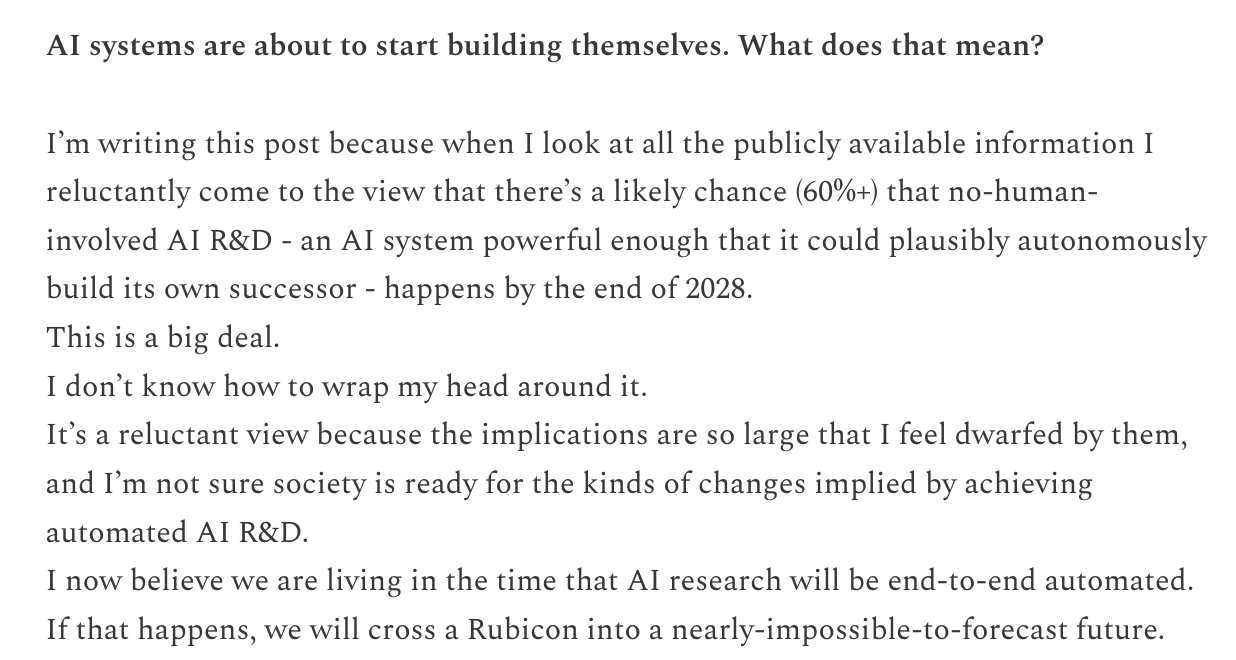
Jack Clark isn't a Twitter provocateur. He's a co-founder of Anthropic — one of the most safety-focused AI labs in the world — and a former policy director at OpenAI. When he posts that he reluctantly believes there's a 60%+ chance that fully automated AI R&D happens by the end of 2028, the word "reluctantly" is doing a lot of work.

The claim: an AI system powerful enough to autonomously build its own successor — with no human involvement in the research and development loop — is more likely than not to exist within three years.

Clark's words: "I now believe we are living in the time that AI research will be end-to-end automated. If that happens, we will cross a Rubicon into a nearly-impossible-to-forecast future."

He said he doesn't know how to wrap his head around it. That's not hedging. That's honesty from someone who has spent years trying to think clearly about exactly this.

HHe6RMZaIAEBwFd

This Isn't a Single Data Point

Clark's conclusion isn't intuition. It's a mosaic assembled from multiple converging benchmarks, each measuring a different slice of AI's capacity to do AI research autonomously.

CORE-Bench measures whether AI can implement other research papers — reading a study, interpreting the methodology, and replicating the results. A huge proportion of real AI research is exactly this: building on prior work. Progress here is consistently up and to the right.

PostTrainBench tasks powerful models like Claude Opus 4.6 with autonomously fine-tuning weaker open-weight models to improve their performance — essentially AI doing the post-training work that currently requires specialized human researchers. Progress here too.

MLE-Bench draws tasks from real Kaggle competitions — diverse, ecologically valid machine learning problems with no predefined solution path. Same trend.

SWE-Bench, which measures AI's ability to resolve real software engineering issues, is the most widely known, and the progress there has been well-documented. Clark's point is that the same trajectory shows up at every resolution, from the famous benchmarks to the niche ones. It's fractal. Every slice of AI R&D capability is moving in the same direction at meaningful speed.

What "Automated AI R&D" Actually Means

The concern isn't that AI will write better code or summarize research papers faster. It's the recursive implication: if an AI system can conduct the research required to build a more capable AI system, the development cycle no longer requires the bottleneck of human researchers. Progress stops being limited by how many brilliant people you can hire and how fast they can think.

The term for this in the research community is an "intelligence explosion" — a concept that has lived mostly in theoretical AI safety literature for decades. Clark is saying the preconditions for it are assembling in benchmarks you can look up right now, not in some speculative future scenario.

He describes feeling "dwarfed" by the implications. That's not a rhetorical flourish. It's a precise description of what happens when you try to reason about a system that outpaces the reasoning capacity you're using to evaluate it.

The Question Nobody in Business Is Asking Loudly Enough

Most enterprise AI conversations in 2026 are about productivity gains, workflow automation, and competitive positioning. Those are legitimate and important. But they exist inside an assumption that the humans remain in charge of the development trajectory — that we are using AI, not the other way around.

Clark's post is an invitation to question that assumption with real evidence rather than science fiction framing. The benchmarks are public. The progress is measurable. The timeline is short.

For marketing and growth leaders, the honest response isn't panic and it isn't dismissal. It's the same response that serious risk management always requires: take the signal seriously before you need to. Understand what you're building on top of. Ask your AI vendors what they actually believe about where this is going — and notice whether their answers match their infrastructure spending.

The companies treating AI as a tactical tool while the foundations shift beneath them will have the hardest time adjusting. Winsome Marketing helps growth teams build AI strategy with that kind of long-range clarity. Let's talk.