

 Writing Team
-Jun-17-2026-07-22-37-0367-PM.png)
The most powerful publicly available AI model in the world just got pulled from every customer, everywhere, because the U.S. government decided it was too capable to share with foreign nationals. The second most powerful model is still online, available to anyone with an OpenAI subscription.
That asymmetry is worth examining carefully.
Key Points
- Fable 5 is gone (for now): After the Trump administration issued an export control directive barring foreign nationals from using Claude Fable 5, Anthropic disabled it for all users to comply.
- Anthropic says other models can do the same: In its statement, Anthropic specifically named GPT 5.5 as a model capable of the same vulnerabilities the government cited as justification for the ban.
- The benchmarks are striking: Fable 5 led every major leaderboard it was ranked on, including Arena, Artificial Analysis, and Simple Bench, with GPT 5.5 placing fourth behind three Anthropic models.
- Mythos remains unreleased: Fable 5 is described as the "safe" version of a more powerful model, Mythos, that Anthropic has not released publicly due to potential dangers.
- Pricing gap existed before the ban: Fable 5 was priced at $10 per million input tokens and $50 per million output tokens. GPT 5.5 starts at $5 and $30 respectively.
The Fable 5 Ban
The Trump administration issued an export control directive barring foreign nationals from using Claude Fable 5. Anthropic, unable to selectively enforce the restriction at the user level, disabled Fable 5 for its entire customer base to comply. The company stated it believed the order was connected to a government effort to use Fable 5 to identify vulnerabilities through a "jailbreak" method. Anthropic's position was that other models, including GPT 5.5, could perform the same functions without requiring a bypass.
There are too many unknowns to independently verify that claim. What is verifiable is the benchmark data.
The Performance Gap Was Real
Before the ban, Fable 5 sat at the top of the Arena leaderboard. The second and third spots were held by Claude Opus 4.7 Thinking and Claude Opus 4.8 Thinking. GPT 5.5 was fourth. Anthropic's own comparison data showed Fable 5 leading GPT 5.5 across agentic coding, knowledge work, vision, scientific research, and cybersecurity benchmarks. Fable 5 also led on Artificial Analysis and Simple Bench.
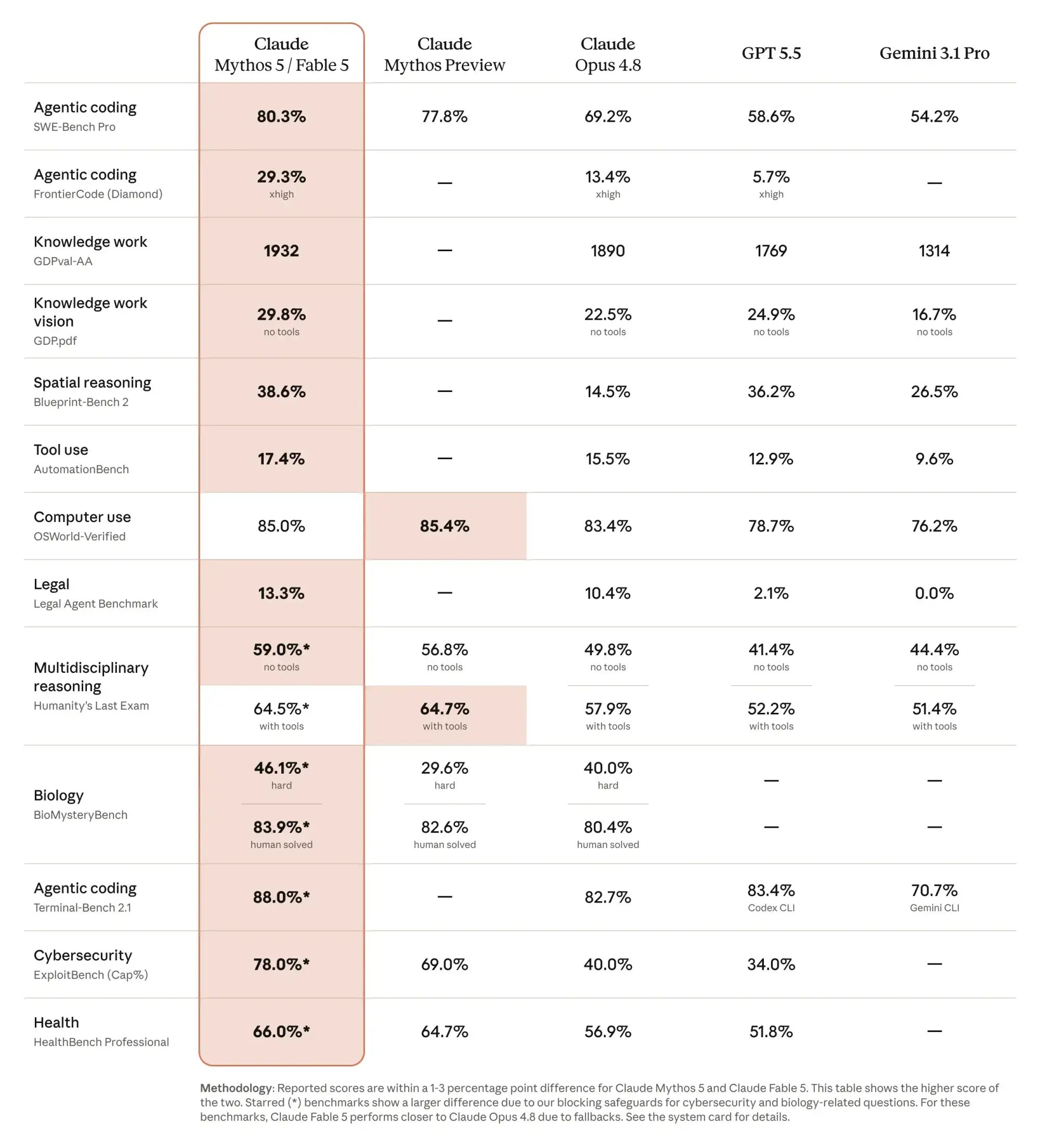
Anthropic described Fable 5 as state-of-the-art on nearly all tested benchmarks, noting that its advantage grew with task complexity and length. That last point is particularly relevant to the government's concern: the more demanding and sophisticated the task, the larger Fable 5's lead.
If the directive was based on how effectively a model could be used for harmful purposes, the benchmark data provides a plausible rationale for why Fable 5 was targeted and GPT 5.5 was not. Capability is the variable.
Anthropic's Uncomfortable Position
This is a genuinely difficult situation for Anthropic. The company has been more vocal than most about AI safety, publishing extensive research on model behavior, maintaining a cautious public release cadence, and holding back Mythos entirely because of concerns about what it could do in the wrong hands. Fable 5 was explicitly described as the safer public version of that more powerful unreleased model.
The irony is that Anthropic's safety posture may have contributed to the government's assessment. A company that openly discloses what its models are capable of, publishes detailed safety research, and acknowledges the existence of a more dangerous model it has not released is providing a cleaner basis for a regulatory decision than a company that says less.
OpenAI, whose GPT 5.5 remains available globally, named its own model capabilities in more measured terms: improved agentic coding, computer use, knowledge work, and early scientific research. Functionally similar territory. Different framing.
What This Signals for AI Companies and Their Customers
The Fable 5 ban is the clearest example yet of government intervention directly affecting AI product availability at scale. Not through proposed regulation, not through a hearing, but through an executive directive that forced a company to immediately remove its flagship product from every paying customer simultaneously.
For enterprise teams and developers who had built workflows around Fable 5, that disappearance was abrupt. The model was available, then it was not. No transition period, no migration path at launch. This is a new kind of platform risk that has no real precedent in software history: a product being removed not because of a business decision but because of a national security order.
The existence of Mythos adds another layer. Anthropic is sitting on a model it considers too dangerous to release publicly while the government has now determined that Fable 5, the safer version, is too dangerous to make available to foreign nationals. That gap between what can be built and what can be responsibly deployed is widening, and the regulatory response to it is becoming less theoretical.
For marketing teams and growth leaders, the immediate practical question is continuity planning. If a core AI tool in your stack can be removed by executive order in 24 hours, what does your workflow look like the next morning? Our AI strategy work at Winsome Marketing increasingly includes exactly this kind of infrastructure resilience thinking alongside the performance questions.
The longer question is harder: if the most capable models are going to face increasing regulatory friction, and the safety-focused companies are going to face more scrutiny than the ones that say less, what does that do to the incentives for transparency? That is a question the industry has not answered yet, and the Fable 5 ban just made it more urgent.
If your team is navigating AI tool selection and continuity risk in an environment where the rules are changing fast, we can help.