How to Extract Unique Insights Without Traditional Content Interviews
Here's a problem every content agency faces: Your clients want content that showcases real expertise. They want unique insights from their subject...
5 min read
Cassandra Mellen
:
Dec 14, 2025 4:15:41 PM
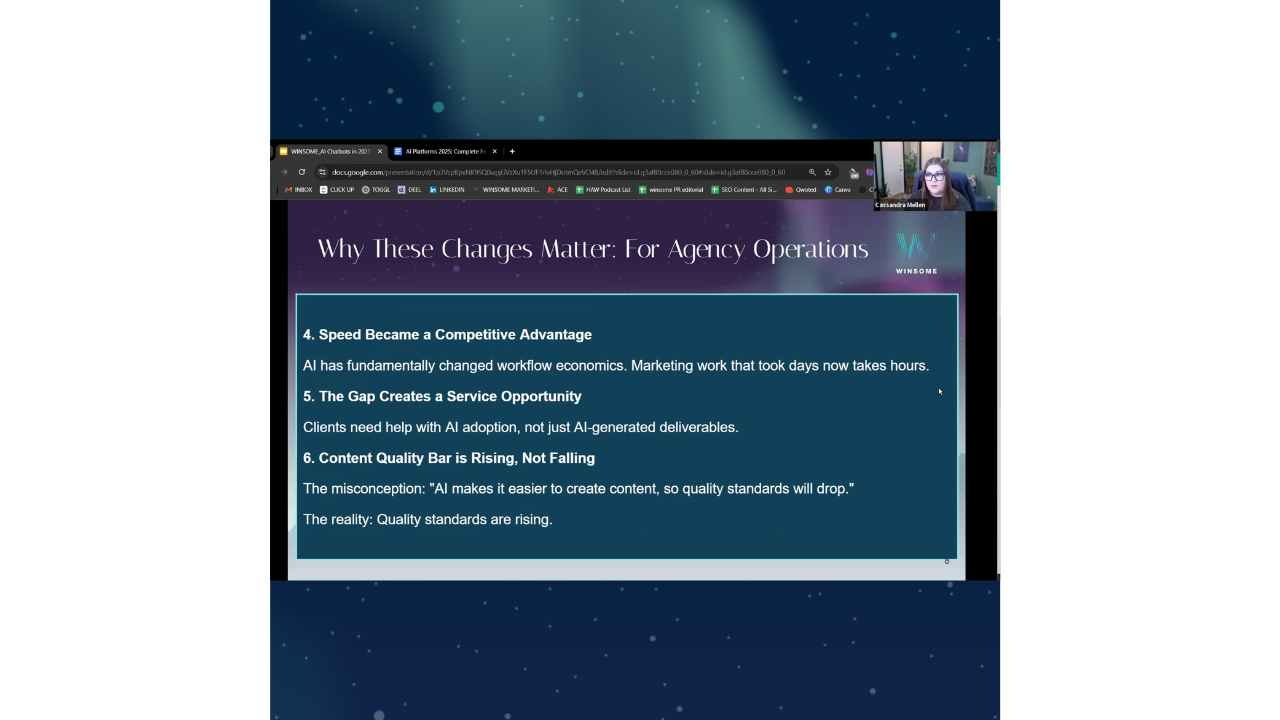
There's a misconception that AI makes it easier to create content, so quality standards will drop. The reality? They're rising.
I've watched this shift happen throughout 2025, and it's been the opposite of what everyone predicted. AI didn't democratize mediocrity—it exposed it. And now, quality is the only thing that cuts through.
AI floods the market with mediocre content. That part is true. Anyone can generate a blog post in thirty seconds now. Tools are everywhere. The barrier to content creation essentially disappeared.
But here's what the pessimists missed: standing out requires excellence. When the baseline is "anyone can generate something," the only differentiator left is quality. Real quality. The kind AI can't fake.
Users can spot AI-generated generic content, and they tune it out instantly. Search and discovery is more competitive than ever, so only the best content gets surfaced. Not the most content. Not the fastest content. The best content.
According to the McKinsey State of AI report, 88% of organizations now use AI in at least one business function. That means almost everyone has access to the same content generation tools. The competitive advantage isn't in having AI anymore—it's in using it to elevate quality, not replace it.
At the start of the year, the primary use for AI was basic troubleshooting, writing help, and summaries. Now, 81% of U.S. adults have used AI search tools in the past three months, and it's becoming a first stop shop for research and information.
That shift matters because people know what AI-generated content looks like now. They've seen thousands of variations of the same bland article structure. They recognize the patterns—the predictable intros, the generic advice, the lack of specific insight.
When everyone's content is AI-generated and sounds the same, the only content that gets attention is the content that doesn't sound like AI. Content with a distinct voice. Content with original research. Content with specific insights that you can't get by typing a prompt into ChatGPT.
Search and discovery fragmented this year too. Discovery is happening across Google, AI tools, TikTok, Reddit, and more. Each generation has different default platforms they go to. Gen Z—35% of them now use AI chatbots for search queries instead of Google, and 40% start from TikTok and Instagram. Gen X and Boomers still Google first, but AI usage is growing for specific tasks even there.
What this means: your content has to compete everywhere. And on every platform, quality is what breaks through the noise.
Brands need distinct voice and specific insights. I think we're doing this really well with some of our clients—creating content that sounds like them, not like every AI tool.
Research must be deeper and more original. You can't just repackage the same top-ten lists everyone else is publishing. You need perspectives that come from actual experience. Data that's not available in every other article. Examples that are specific and concrete, not hypothetical scenarios that sound plausible but aren't real.
Human strategy and editing are more valuable than ever. The initial draft might come from AI, but the value comes from the human who knows what to cut, what to expand, what angle to take, what story to tell. Teams are relearning how to write from a strategy-first mindset instead of a fill-space mindset.
People are thinking and communicating differently because AI drafts so much of their first version. But the thinking part—that's what matters. AI can generate words. It can't generate insight.
Language norms are shifting because of AI. Teams are moving away from generic AI-generated words and overused phrasing. Clients recognize them instantly, and audiences tune them out.
There are words that AI uses all the time that I try to avoid now when I'm talking to somebody. Words like "delve" and "leverage" and "navigate." Phrases like "picture this" or things that always come in threes. The em dash used excessively.
These weren't bad words. They were good words. But AI overused them to the point where they signal "this was generated, not written." And once your audience spots that pattern, you've lost their trust.
Content needs to feel distinct again. Brands want language that sounds like them, not like every AI tool. We've been doing a good job of sharing those patterns when we find something new or a way to avoid them.
Marketers are adapting their writing habits to avoid predictable patterns. That's quality work—noticing the patterns, understanding why they fail, consciously choosing different approaches.
AI answers questions directly instead of sending users to websites now. That fundamentally changes visibility. Brands must be present where AI pulls its information—using a blend of public content, structured data, citations, and high-authority signals.
If clients don't publish enough credible content, they'll fall out of the AI ecosystem entirely. And "credible" is the key word there. AI platforms are getting better at identifying authoritative sources. They're pulling from sites with strong reputations, consistent messaging, original research.
You can't game that with volume. Publishing a hundred mediocre AI-generated articles won't make you authoritative. It'll make you look like everyone else who's publishing a hundred mediocre AI-generated articles.
For AI to read your site and your brand, you almost need to have consistent messaging across all platforms. That would be your leadership team, the website, all your social platforms. AI is grabbing information from all of that, so consistent, high-quality messaging gives you a better shot of being understood correctly and being cited as a credible source.
Speed became a competitive advantage this year, but not the kind of speed people expected. It's not about publishing faster. It's about reallocating time from execution to strategy. Taking manual tasks that AI can handle and using that time for creative problem solving instead.
I was interested to know about the number of blogs we produced as a team in January compared to now. I feel like that would be a skyrocket. But the blogs we're producing now are better than the blogs we produced in January, even though we're producing more of them. Because we're using AI to handle the parts that don't require human insight, and we're investing our human time in the parts that do.
The gap is that clients need help with AI adoption—not just AI-generated deliverables. They need training on how to use AI to elevate quality, not replace it. They need strategy on what to automate and what to keep human. They need systems that combine AI efficiency with human insight.
Content quality bar is rising, not falling. That's the reality of 2025. AI made content creation easier, which paradoxically made quality content more valuable.
When everyone can create something, the only differentiator is creating something good. Original research that provides new data. Distinct voice that sounds human. Specific insights that come from experience. Examples that are real, not hypothetical. Strategy that understands the audience and speaks to them specifically.
AI is embedded everywhere now—Microsoft 365, Google Workspace, Adobe, even our phones. The tools are ubiquitous. Access is universal. The competitive advantage is in how you use those tools, not whether you have them.
Use them to handle the repetitive work so you can focus on the insight work. Use them to draft faster so you can think deeper. Use them to free up time for the strategic, creative, human work that actually differentiates your content from everyone else's.
Because in a world where everyone has AI, quality is the only thing that matters.
AI tools are everywhere, which means generic content is everywhere. At Winsome Marketing, we use AI to handle execution so we can focus human expertise on strategy, insight, and quality—creating content that actually breaks through in 2025's competitive landscape.
Ready to create content that doesn't sound like everyone else's? Let's build a strategy around quality that AI can't replicate.
Here's a problem every content agency faces: Your clients want content that showcases real expertise. They want unique insights from their subject...
Your website visitors are drowning in information.
Your industry's content all looks the same because everyone's copying each other.