3 min read

Content Velocity vs. Content Depth: The Quality-Quantity Paradox

Content Velocity vs. Content Depth: The Quality-Quantity Paradox
7:38

Your competitor publishes daily. You publish monthly. They rank for 500 keywords. You rank for 50. But your 50 drive more conversions than their 500. Who's winning?

The answer is: you're playing different games entirely.

The Velocity Argument

Content velocity—publication frequency—compounds. Each article is a lottery ticket for rankings, backlinks, social shares. More tickets mean more chances to win. Publish 100 mediocre articles, and probabilistically several will succeed. Publish ten exceptional articles, and you're hoping excellence guarantees success.

It doesn't. Excellence improves odds but can't overcome volume's mathematical advantage. Automated content creation promised to solve this—velocity without sacrificing quality. It delivered velocity without quality, proving that automation optimizes for the wrong variable.

Velocity also builds topical authority faster. Google measures domain expertise partly through breadth—covering many aspects of a topic signals comprehensive knowledge. One deep article about content strategy can't compete with twenty articles covering content strategy from different angles, even if the single article is superior to any individual piece in the set.

The Depth Argument

Deep content—comprehensive, thoroughly researched, genuinely insightful—creates compounding value. Shallow content generates temporary traffic then decays. Deep content accumulates backlinks, sustains rankings, continues generating value years after publication.

Quality content became non-negotiable specifically because velocity without depth created an internet full of content nobody trusts. Surface-level articles proliferated until depth became the differentiator. When everyone can publish quickly, few publish well.

Depth also serves different search intents. Quick answers serve informational intent. Deep analysis serves research intent. Depending on your audience, depth might matter more than coverage. B2B buyers researching six-figure purchases need depth. Consumer product browsers need velocity.

The False Trade-Off

The velocity versus depth framing assumes these variables oppose each other. They don't—they serve different strategic purposes. Velocity optimizes for coverage and discovery. Depth optimizes for authority and conversion. The question isn't which to choose but which your goals require.

Scaling content without subject matter experts forces this trade-off explicitly. You can produce more content faster, or you can produce expert-vetted depth slower. Both are legitimate strategies with different outcome profiles. Neither is universally superior.

Velocity's Hidden Costs

High-velocity publishing creates maintenance debt. Each article requires eventual updates, link maintenance, accuracy verification. Publish 200 articles annually, and within three years you're maintaining 600 pieces while trying to publish 200 more. Content entropy affects shallow content faster—surface-level insights age poorly compared to fundamental principles.

Velocity also dilutes brand voice. Maintaining consistent perspective across high-volume output requires either rigid templates (which readers notice) or accepting inconsistency (which damages brand perception). The voice that makes content memorable can't survive industrial production speeds.

New call-to-action

Depth's Hidden Costs

Deep content demands expertise that doesn't scale. One person can write 100 shallow articles through research alone. Writing ten deep articles requires genuine domain mastery. Thought leadership content suffers when companies try to scale depth—you can't automate genuine insight.

Depth also has diminishing returns. The difference between a 500-word overview and a 1,500-word article is substantial. The difference between 3,000 words and 5,000 words? Often negligible for user value, significant for production cost. At some point you're optimizing for completeness that nobody wants.

The Hybrid Strategy

Most successful content operations run hybrid models: velocity for coverage, depth for conversion. Publish frequent, focused articles targeting long-tail keywords (velocity). Supplement with comprehensive guides targeting competitive head terms (depth). Use velocity to build topical authority breadth, depth to convert that traffic.

This requires accepting that content serves different functions. Not every piece needs to be your best work. Some content exists to establish presence in semantic clusters. Other content exists to convert visitors already convinced of your expertise. Strategic content partnerships help—external experts contribute depth while internal teams maintain velocity.

Audience Tolerance for Volume

Different audiences tolerate different publication frequencies. Daily content works for news-oriented topics where audience expectations include regular updates. Monthly deep dives work for technical subjects where audience expects substance over speed.

Publishing too frequently for your audience creates habituation—they stop noticing your content because the pattern becomes environmental noise. Publishing too infrequently risks irrelevance—they forget you exist between publications. The optimal velocity varies by topic, audience, and competitive intensity.

The Algorithmic Reality

Search algorithms reward both velocity and depth, but differently. Velocity helps dominate long-tail search through covering many related queries. Depth helps rank for competitive head terms requiring comprehensive topic treatment. SEO strategy that ignores either dimension underperforms.

Social algorithms favor velocity—frequent posting increases odds of catching trending topics and algorithmic boosts. But they also punish repetitive low-quality content through engagement decline. The balance shifted when platforms added "show less from this source" features—velocity without quality now actively damages reach.

The Resource Allocation Question

The real optimization problem isn't quality versus quantity—it's how to allocate limited resources between them. You have finite budget, expertise, and time. Every dollar spent increasing velocity can't be spent improving depth, and vice versa.

The answer depends on competitive positioning. If competitors dominate through depth, velocity might be your differentiation path. If they're flooding the zone with shallow content, depth becomes your competitive advantage. The worst strategy is trying to match competitors on their chosen dimension—compete where they're weak, not where they're strong.

Beyond the Paradox

Content velocity and depth aren't paradoxical—they're complementary variables serving different strategic functions. Successful content operations optimize both, understanding which articles need velocity and which need depth based on strategic purpose.

The question isn't "quality or quantity?" It's "which type of content achieves which specific goal?" Answer that, and the velocity-depth trade-off resolves itself into strategic resource allocation decisions.

Want to optimize your content operation for both velocity and depth based on what your specific business needs? We build content strategies that allocate resources to the right types of content at the right frequency. Let's talk about balancing velocity and depth strategically.

AI Didn't Kill Quality Content—It Made It Non-Negotiable

AI Didn't Kill Quality Content—It Made It Non-Negotiable

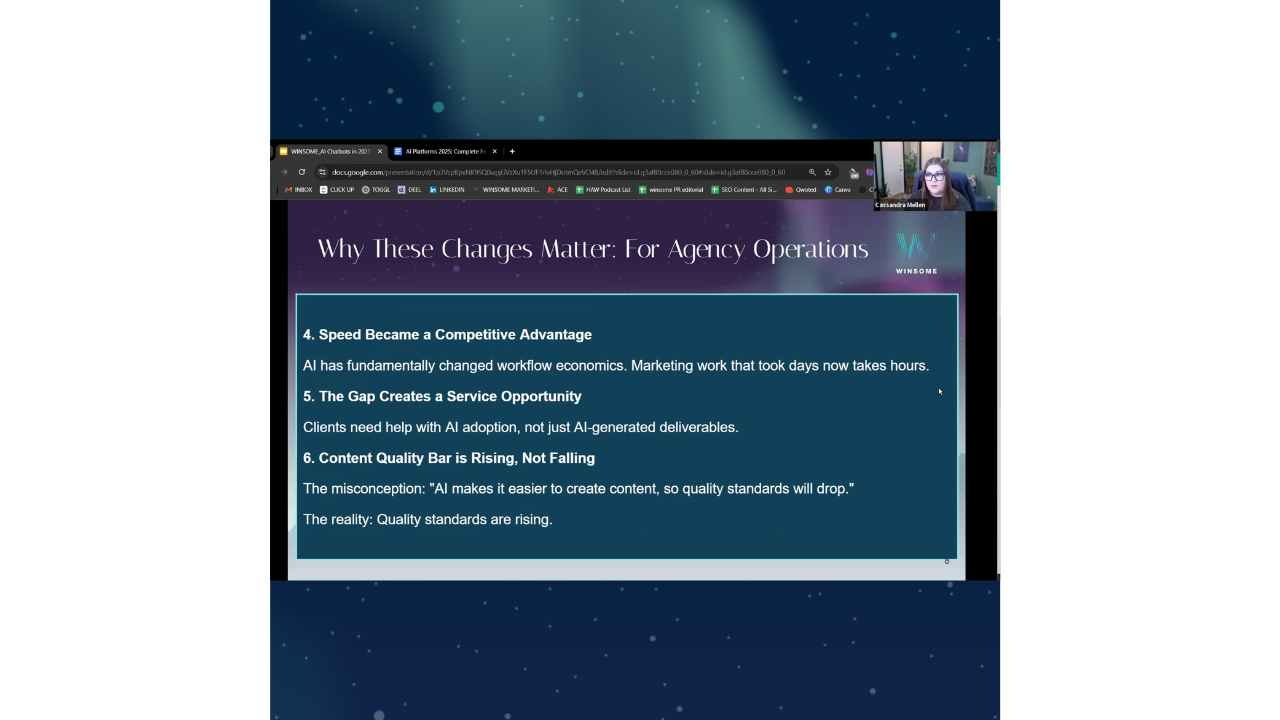
There's a misconception that AI makes it easier to create content, so quality standards will drop. The reality? They're rising.

Read More
Content Velocity vs. Content Volume: Finding Your Publishing Sweet Spot

Content Velocity vs. Content Volume: Finding Your Publishing Sweet Spot

Most content strategies suffer from one of two problems: publishing too little to gain momentum, or publishing so much that quality collapses under...

Read More
Google Discover's AI Mode Push: Summarizing Your Content Before You Finish Reading It

Google Discover's AI Mode Push: Summarizing Your Content Before You Finish Reading It

Google now offers AI Mode options directly within articles you're reading through Discover. Click the three-dot menu on any webpage in the Google...

Read More