GPT-5.2 Solves an Open Math Problem. Now What?
OpenAI announced this week that GPT-5.2 Pro solved an open research problem in statistical learning theory without human scaffolding. Not "helped...
An open weights model just pulled level with GPT-5.5 on the benchmarks that measure real-world work. That is not a minor footnote.
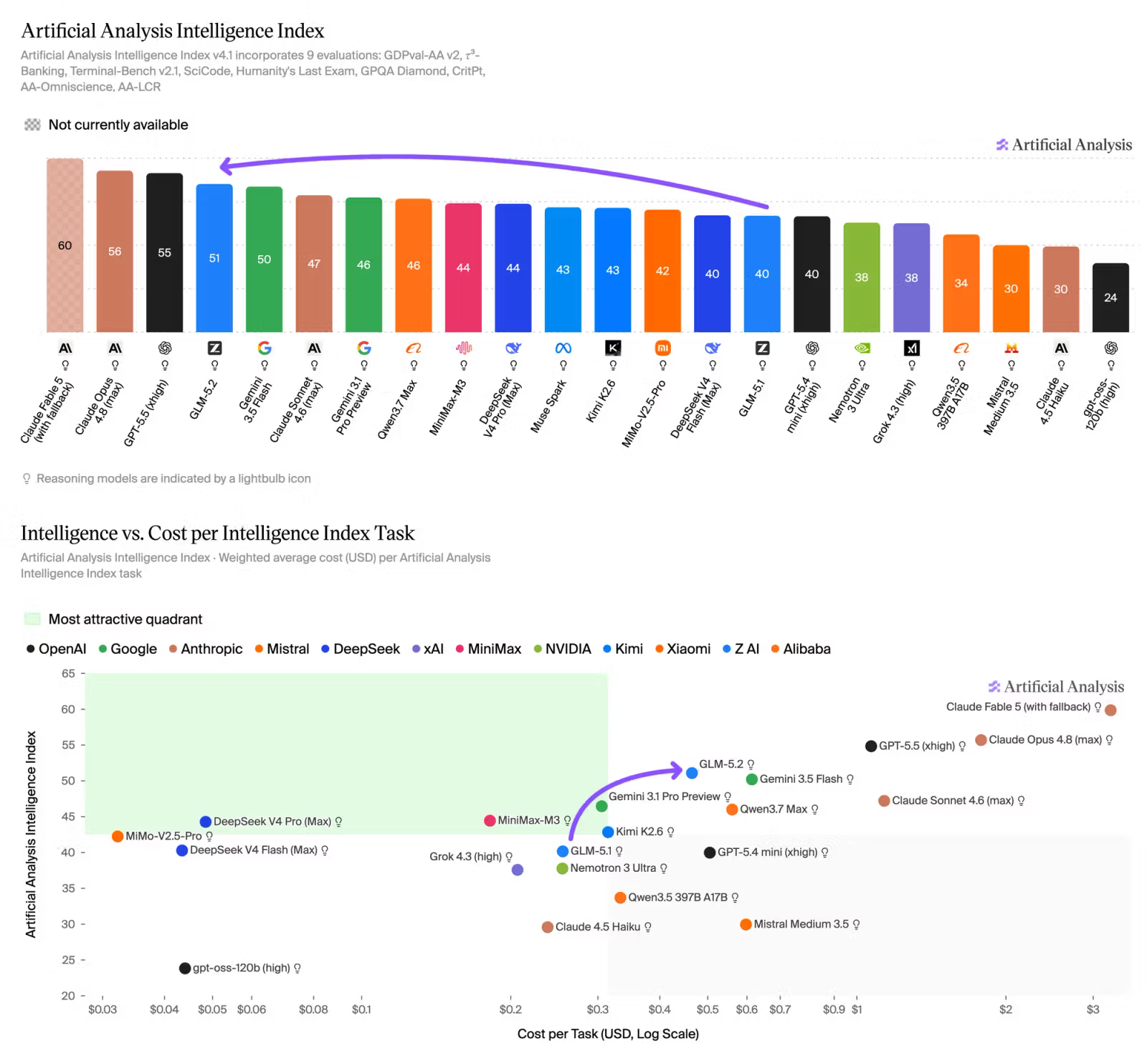
Z.ai's GLM-5.2, evaluated by Artificial Analysis and published to their model comparison index, now leads every open weights model on the Intelligence Index v4.1 with a score of 51. More significantly, on GDPval-AA v2, the metric designed to measure agentic performance across longer, multi-turn tasks, GLM-5.2 scores 1524 against GPT-5.5 xhigh reasoning's 1514. For practical purposes, those are the same number.

The jump from GLM-5.1 to 5.2 is eleven points on the Intelligence Index, which is substantial given the model size is identical. Z.ai achieved this without scaling parameters — the architecture stays at 744B total and 40B active — which means the gains came from training and optimization rather than raw compute.
The benchmark improvements tell a specific story. Scientific reasoning leads the way: CritPt climbs 16 points to 21%, HLE gains 12 points to 40%, and SciCode rises 7 points to 50%. Terminal task performance on TerminalBench v2.1 improves 16 points to 78%. GPQA Diamond, a graduate-level reasoning benchmark, now sits at 89%. These are not marginal increments on easy tests.
The hallucination rate also dropped. On the AA-Omniscience Index, GLM-5.2 scores 4, up from 2 on GLM-5.1. The improvement comes from both higher accuracy (25.1% versus 24.2%) and a lower hallucination rate (28.1% versus 29.4%). For any application where factual reliability matters, that directional movement is worth noting.
The GDPval-AA v2 score is the number that changes the conversation. This benchmark measures real-world agentic performance across multi-turn tasks with a 250-turn limit, calibrated against human performance at an Elo of 1000. GLM-5.2 at 1524 places it ahead of MiniMax-M3 at 1418 and DeepSeek V4 Pro at 1328 — and level with GPT-5.5.
That alignment matters for enterprise buyers evaluating whether to build on open weights infrastructure or stay on proprietary APIs. The capability gap that once justified proprietary pricing is narrowing in measurable, indexed ways. GLM-5.2 is an MIT-licensed model available not only through Z.ai's first-party API but across DeepInfra, Novita, Nebius, Parasail, Siliconflow, GMI Cloud, Baseten, and Fireworks. Organizations that want to run this at scale have genuine options.
The context window expansion from 200K to 1M tokens is a quiet but significant upgrade for teams running agent workflows, long-document analysis, or any task that requires retaining substantial context across a session.
GLM-5.2 sits on the Pareto frontier of intelligence versus cost per task — meaning no other model at its intelligence level costs less. At approximately $0.46 per task on the first-party API, it is more expensive per task than GLM-5.1 ($0.25), MiniMax-M3 ($0.18), and DeepSeek V4 Pro ($0.05). The reason is token usage: GLM-5.2 generates 43,000 output tokens per Intelligence Index task, of which 37,000 are reasoning tokens. That is a meaningful increase from GLM-5.1's 26,000 and above most open weights peers.
The honest read here is that GLM-5.2 thinks longer to get better answers. For tasks where accuracy and reasoning depth drive the outcome — scientific analysis, complex agent workflows, long-context legal or financial document work — the additional token cost is a reasonable trade. For high-volume, lower-complexity production tasks, cheaper models in the same ecosystem may still be the right call. The Pareto frontier position means you are not overpaying for intelligence you cannot get elsewhere at the same price. It does not mean this is the cheapest model available.
The gap between what open and proprietary models can do is the central budget and build question for every growth team investing in AI infrastructure right now. GLM-5.2 moves that conversation meaningfully. A model that performs at GPT-5.5 levels on agentic benchmarks, carries an MIT license, and runs on eight different infrastructure providers is a serious option for teams that have been priced out of proprietary APIs or want more control over their stack.
For marketing specifically, the scientific reasoning and long-context improvements have direct applications: competitive analysis, large-scale content synthesis, multi-document research, and complex campaign logic all benefit from a model that can reason deeply across extended inputs without losing coherence.
The open weights model is no longer a compromise. At this benchmark level, it is a choice.
If your team is working through which AI infrastructure actually fits your use case and budget, the growth strategy team at Winsome Marketing helps clients make those decisions with clear criteria. Start the conversation here.
OpenAI announced this week that GPT-5.2 Pro solved an open research problem in statistical learning theory without human scaffolding. Not "helped...
Four network layers: the AI falls on its face navigating a maze. 1,024 layers: the same agent walks upright and vaults over walls.
We have a problem with AI that no amount of training data will fix: Large language models hallucinate with confidence, asserting falsehoods as...