5 min read

RIP to All the Words We Can't Use Anymore (Thanks, AI)

RIP to All the Words We Can't Use Anymore (Thanks, AI)

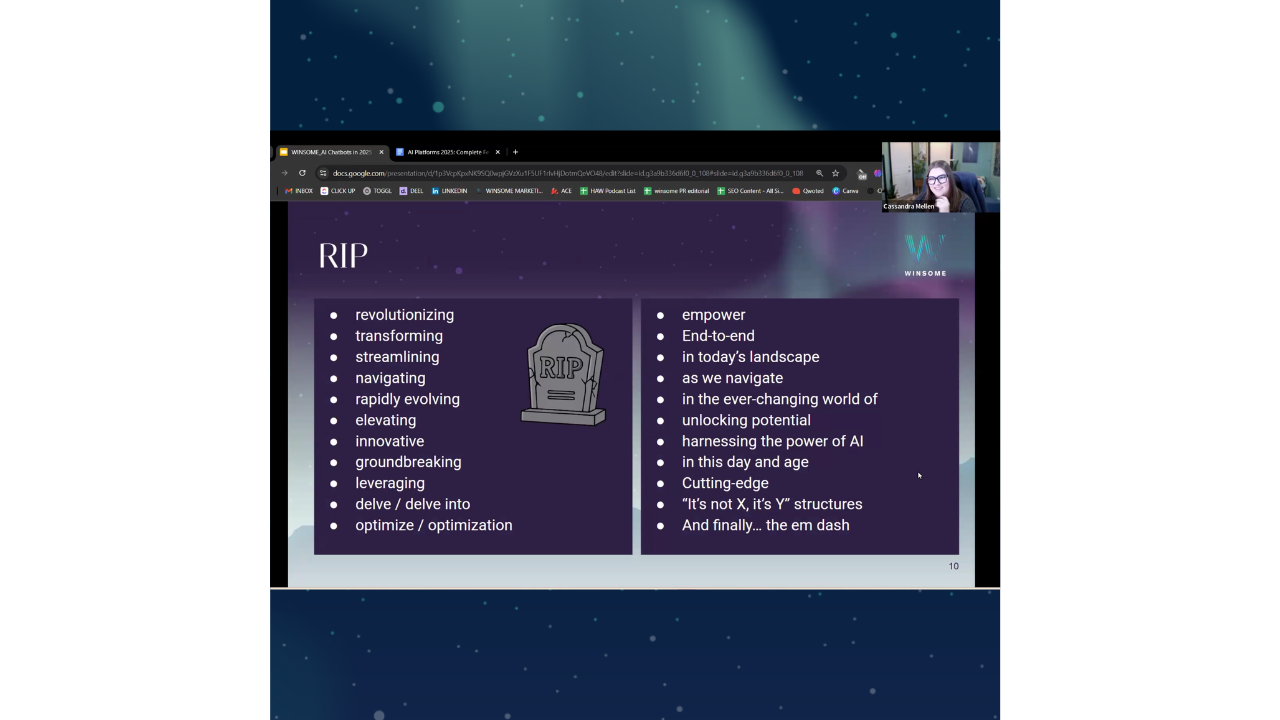
I wanted to have a moment—a little RIP for all the words that we can't really use anymore without getting side-eye, like "was that AI?"

These weren't bad words. They were good words. Useful words. Words that conveyed specific meanings and added texture to writing. But AI overused them to the point where they signal "this was generated, not written." And once your audience spots that pattern, you've lost their trust.

Language norms are shifting because of AI. Teams are moving away from generic AI-generated words and overused phrasing. Clients recognize them instantly, and audiences tune them out.

So here's the eulogy for the vocabulary we lost in 2025.

The Fallen Heroes

Delve. Oh, delve. Delve is such a good word. It means to dig deep, to investigate thoroughly, to really get into something. It's precise. It's evocative. And AI absolutely murdered it.

Every AI-generated article wants to "delve into" the topic. Every summary promises to "delve deeper." The word appears so consistently in AI content that seeing it now is like seeing a watermark. You know immediately what you're reading.

Leverage. This one hurts because leverage is genuinely useful in business writing. You leverage resources. You leverage advantages. You leverage technology. It's the right word for a specific concept.

But AI uses it for everything. Leverage your potential. Leverage opportunities. Leverage solutions. It appears in every third sentence of AI-generated marketing copy, usually paired with other AI favorites in a way no human would actually write.

Navigate. Navigate the landscape. Navigate the challenges. Navigate the complex world of whatever-we're-talking-about. AI loves navigation metaphors, and it's killed all of them.

Landscape. Speaking of which—landscape. The competitive landscape. The digital landscape. The ever-evolving landscape. If I see "landscape" one more time in a marketing context, I might scream. It's not that it's wrong. It's that it appears in literally every AI-generated business article ever written.

Revolutionize. Every product revolutionizes something according to AI. Every solution is revolutionary. Every approach revolutionizes the industry. The word has lost all meaning through sheer overuse.

Discover. This one shows up especially in meta descriptions. "Discover the secrets of..." "Discover how to..." "Discover the power of..." AI defaults to "discover" so consistently that it's become a red flag for generated content.

The Punctuation Casualties

The em dash. I'm sad about the em dash. I feel defiant and want to use it sometimes, but... they don't know me, you know?

The em dash is a beautiful piece of punctuation. It creates emphasis—like this—in a way that commas and periods can't quite achieve. But AI loves it so much that it uses three or four em dashes per paragraph, turning prose into a choppy mess of interruptions.

Now, using an em dash makes you look like you let ChatGPT write your content. That's tragic.

The Structural Patterns

"Picture this" as an intro. Ten years ago, when I had to use "picture this" in my blog, I thought I was the coolest kid on the block. It was engaging! It was scene-setting! It drew readers in!

Now it's AI's favorite opening line. "Picture this: you're trying to..." followed by a hypothetical scenario that's meant to hook you but just signals that you're about to read generated content.

Things coming in threes. If you're describing something, AI always gives you three examples. Three benefits. Three features. Three reasons. Three steps. Everything is three.

This isn't inherently wrong—threes are a classic rhetorical device. But AI is so predictable about it that when you see a list of exactly three things, you immediately wonder if a human actually wrote this or if it was generated.

Lists that are too balanced. Similarly, AI loves perfectly balanced bullet points where each item is roughly the same length and structure. Real human writing is messier. Some points are longer. Some are shorter. Some break the pattern. AI doesn't do that naturally.

The Phrases That Got Overused

"Unleash your potential." Or unleash anything, really. Unleash innovation. Unleash growth. Unleash possibilities. AI is very concerned with unleashing things. All of the unleashing happening is really disturbing. It's unhinged.

"The power of." The power of collaboration. The power of AI. The power of whatever concept we're discussing. AI defaults to "the power of" constantly, and it's made the phrase essentially unusable.

"In today's fast-paced world." This might predate AI, but AI has beaten it completely to death. If your article starts with anything about today's fast-paced world or rapidly evolving landscape or ever-changing environment, everyone knows what they're about to read.

Why This Actually Matters

This isn't just about vocabulary snobbery. It's about trust and credibility.

Users can spot AI-generated generic content, and they tune it out instantly. When readers recognize these patterns, they stop taking your content seriously. They assume it's low-effort. They assume you don't have real insights. They move on.

Content needs to feel distinct again. Brands want language that sounds like them, not like every AI tool. We've been doing a good job as a team of sharing these patterns when we find something new or a way to avoid them.

Marketers are adapting their writing habits to avoid predictable patterns. That's necessary work now. You have to actively avoid the words and phrases and structures that AI defaults to, even when they might technically be correct, because they've been so overused that they undermine your credibility.

The Broader Language Shift

I think it'll be interesting to look back a few years from now just to see how people are communicating in person as well. There are words that AI uses all the time that I try to avoid now when I'm talking to somebody. Like "actually"—when AI puts that in there to sound a little bit more human, I'm like, why am I doing that?

Language is evolving because of AI in ways that go beyond just written content. We're all becoming more conscious of these patterns. We're noticing when something sounds generated versus authentic. We're adjusting our own communication to avoid those patterns.

Teams are moving away from generic AI-generated words and overused phrasing not just because clients recognize them, but because we recognize them. We've trained ourselves to spot the tells. And once you see them, you can't unsee them.

What We Use Instead

So if we can't use delve, leverage, navigate, or any of the other casualties, what do we use?

The answer is: more specific language. More varied sentence structures. More human imperfection.

Instead of "delve into," we might say "examine" or "look at" or "explore" or just get into the topic without announcing that we're getting into it. Instead of "leverage resources," we might say "use" or "deploy" or "take advantage of"—whatever fits the specific context best.

The key is variety and specificity. AI defaults to the same patterns because those patterns are statistically common in its training data. Humans avoid those patterns by thinking about what we actually mean and choosing words that fit that specific meaning in that specific context.

We use shorter words sometimes. Longer words other times. We vary sentence length. We break rules occasionally. We write the way people actually think and talk, which is messier and less predictable than AI's statistical averages.

The New Bar for Content

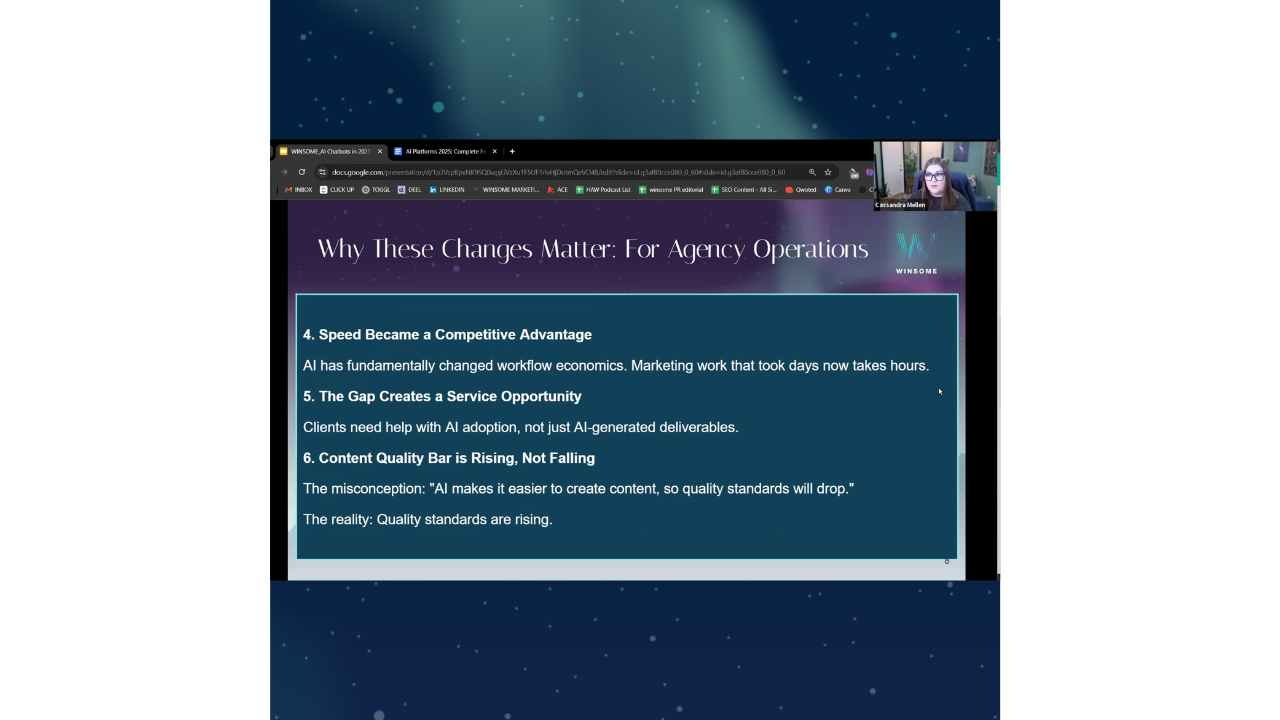
This is part of why the content quality bar is rising, not falling. AI floods the market with mediocre content that all sounds the same. Standing out requires excellence—which includes sounding human.

People are thinking and communicating differently because AI drafts so much of their first version. We're all becoming editors now, trained to spot and eliminate the patterns that signal generated content.

That's actually a good thing. It's making us better writers. More intentional about word choice. More conscious of voice and style. More willing to break patterns and take risks with language.

But it also means we had to sacrifice some perfectly good words along the way. Words that were useful and precise but got so overused by AI that they became unusable.

So pour one out for delve. For leverage. For navigate and landscape and revolutionize. For the em dash used with abandon. For "picture this" and threes and unleashing potential.

They served us well. But in 2025, they belong to AI now. And we have to find new ways to say what we mean.

Create Content That Sounds Human, Not Generated

In a world where AI has claimed half the vocabulary, standing out means writing with distinct voice and intentional word choice. At Winsome Marketing, we help brands create content that doesn't trigger the "was this AI?" question—because it sounds genuinely human.

Ready to write content that doesn't sound like everyone else's? Let's build a voice that's distinctly yours, not distinctly AI.

AI Didn't Kill Quality Content—It Made It Non-Negotiable

AI Didn't Kill Quality Content—It Made It Non-Negotiable

There's a misconception that AI makes it easier to create content, so quality standards will drop. The reality? They're rising.

Read More
Voice and Tone: Where Writers Leave AI in the Dust

Voice and Tone: Where Writers Leave AI in the Dust

Listen up, word nerds - let's dive into something juicy. We're talking voice and tone, and let me tell you, this is where we separate the real...

Read More
Will AI Replace Copywriters?

Will AI Replace Copywriters?

The rapid advancement of artificial intelligence (AI) has sparked intense debate across various industries, and the world of copywriting is no...

Read More