What is Generative SEO? Navigating the Future of AI-Driven Search
A new frontier has emerged that's capturing the attention of marketers, content creators, and SEO professionals alike. Generative Search Engine...
4 min read
Writing Team
:
Dec 3, 2025 9:28:53 AM
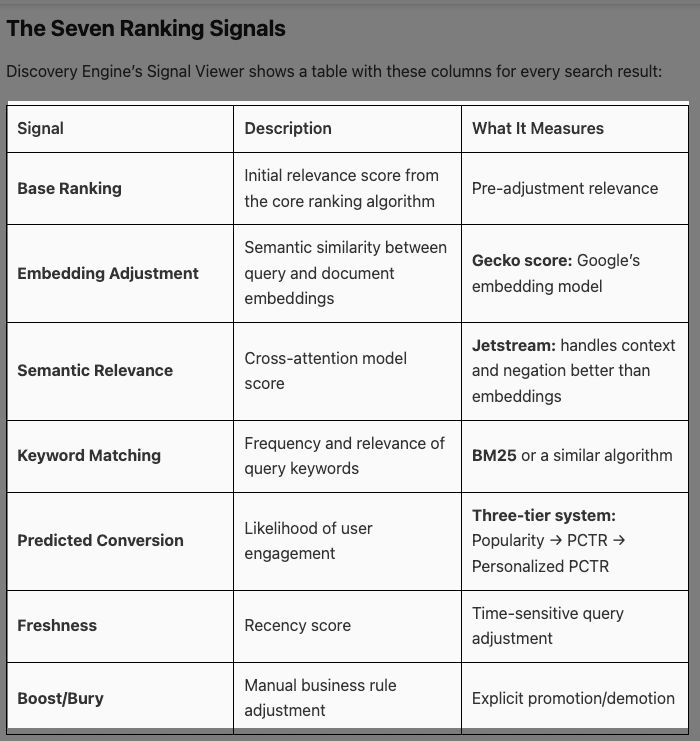
Sometimes the best insights come from places you least expect. SEO analyst Metehan Yeşilyurt recently uncovered something remarkable: Google's enterprise Vertex AI documentation contains explicit signal descriptions that likely mirror what powers AI Mode in search. While Google guards its core algorithm like state secrets, their enterprise product documentation tells a different story. These seven exposed signals give us the clearest window yet into how AI-powered search actually ranks content. What Yeşilyurt found isn't speculation—it's documented methodology from Google's own infrastructure.

Google starts with what they call "base ranking"—an initial relevance score that determines whether your content deserves consideration at all. This score likely uses methodology similar to the core algorithm that's been refined over decades.
The revelation here is what it tells us about AI Mode's architecture. Google didn't scrap traditional ranking and start fresh. They built on top of it. Your content still needs to satisfy fundamental relevance criteria before AI processing even begins. Page authority, backlink profiles, technical SEO health—these factors still matter because they determine your baseline score.
Think of base ranking as the entry fee. Without it, the sophisticated AI layers never activate. This explains why sites with weak technical foundations struggle in AI Mode despite having great content. The AI never gets a chance to evaluate that content because the base ranking filters it out first.
After base ranking, Google calculates an embedding score using their Gecko model. Embeddings are how AI understands semantic relationships—the conceptual distance between your content and a user's query. But Google doesn't stop there.
They run content through a second model called Jetstream. This creates redundancy by design. Gecko might understand broad semantic meaning, but Jetstream catches nuance that the first pass missed. It's like having two editors review your work, each with different strengths.
For content creators, this double-layer approach has clear implications. Surface-level keyword optimization won't cut it. Your content needs depth that survives multiple semantic analyses. When we develop content strategy for clients, we focus on comprehensive topic coverage precisely because shallow treatments get filtered out by one model or the other.
The semantic layer is where AI Mode diverges most dramatically from traditional search. Keywords matter less than conceptual thoroughness. Answer the question completely, anticipate follow-ups, and provide context that demonstrates real understanding.
Here's the surprise: buried in Google's AI infrastructure is traditional keyword matching using BM25—a algorithm from the 1970s. After all the semantic processing and AI analysis, Google still checks for exact keyword matches.
This isn't regression. It's validation. Semantic models occasionally hallucinate relevance where none exists. Keyword matching acts as a sanity check. If your content ranks high on semantic similarity but contains none of the actual terms in the query, something's probably wrong.
The practical takeaway is straightforward. Don't abandon keyword research for pure semantic optimization. Use both. Your content should satisfy AI's semantic understanding while still containing the specific terms people search for. When both signals align, you get ranked. When they conflict, you get filtered.
Google doesn't just guess whether users will engage with your content. They predict it using three distinct data sources, then blend those predictions into a unified engagement score.
First tier: historical user interactions. If people consistently click your results and stay on your pages, that behavior feeds forward. This is why established sites with strong engagement histories have advantages in AI Mode.
Second tier: predicted click-through rate. Google's models estimate CTR based on your title, meta description, and how similar content has performed. This happens before any user sees your result. Poor predicted CTR can bury you regardless of content quality.
Third tier: personalization. Google customizes predictions based on individual user behavior patterns. Someone who frequently reads long-form analysis sees different results than someone who prefers quick answers.
These three signals combine into what Google calls "predicted conversion"—though conversion here means engagement, not sales. The system optimizes for user satisfaction as measured by behavior. This is where our approach to SEO content development focuses heavily on user intent matching. Content that fails to engage gets deprioritized fast, regardless of how well it satisfies other signals.
Query-dependent freshness (QDF) appears explicitly in the documentation. Google determines whether your query demands recent information, then adjusts rankings accordingly. Breaking news queries activate strong freshness signals. Evergreen topics don't. The AI determines which category your query falls into.
But the most intriguing revelation is what Google calls the "boost/bury" system. This is manual override capability based on categorical rules. The AI doesn't have final say—human-created rules can elevate or suppress content based on specific criteria.
This is almost certainly where EEAT (Experience, Expertise, Authoritativeness, Trustworthiness) enforcement happens. Google's AI might think a piece of medical content is semantically perfect, but if it comes from a site without medical authority, the boost/bury system can suppress it anyway.
The freshness component matters more than most SEO professionals realize. We see this in our client work constantly. A well-optimized article from two years ago will get overtaken by a decent article from last month if the query triggers freshness signals. The solution isn't to republish everything weekly. It's to understand which of your topics demand regular updates and which don't.
Authority scoring likely functions similarly. Sites with established domain authority in specific topics get boosted. New sites or sites without topical focus get buried, even when their individual content pieces are strong. This creates a catch-22 for new entrants: you need authority to rank, but you need rankings to build authority.
The manual override system suggests Google doesn't fully trust AI to make these judgment calls. Human-created rules still govern controversial topics, YMYL (Your Money Your Life) content, and categories where algorithmic mistakes carry high costs. For content creators, this means understanding Google's quality guidelines remains essential. The AI operates within guardrails set by human policy decisions.
These seven signals tell us something crucial: AI Mode isn't alien technology. It's traditional ranking factors enhanced by semantic understanding and engagement prediction. Your SEO strategy shouldn't radically change—it should deepen.
Focus on base ranking fundamentals. Build semantic depth into content. Keep keyword targeting. Optimize for engagement. Update when freshness matters. Establish topical authority.
The sites winning in AI Mode do all seven things well, not just one or two. That's why comprehensive content strategy matters more than ever.
Winsome Marketing builds content strategies that satisfy both traditional algorithms and AI-powered search. We don't chase algorithmic tricks—we create comprehensive content that ranks because it deserves to. Let's build your semantic authority from the ground up.
A new frontier has emerged that's capturing the attention of marketers, content creators, and SEO professionals alike. Generative Search Engine...
Your boss is thrilled. Your average position in Google Search Console jumped from 45 to 8.5 overnight. Your rankings look incredible. Your visibility...
Generative Engine Optimization (GEO) is the cutting-edge practice of optimizing content for AI-driven search platforms, such as Google's Search...