
Content Velocity vs. Content Depth: The Quality-Quantity Paradox
Your competitor publishes daily. You publish monthly. They rank for 500 keywords. You rank for 50. But your 50 drive more conversions than their 500....
In the frenzied pursuit of saying everything, most marketers forget the most persuasive tool in their arsenal: silence. Like the white space that makes a Rothko painting breathe, or the pause that makes a comedian's punchline land, what you don't say in your content often carries more weight than what you do.
We live in an age of content bloat, where brands vomit feature lists and benefits until readers' eyes glaze over. Meanwhile, the most sophisticated marketers are wielding negative space like a scalpel, creating content that whispers instead of shouts—and somehow gets heard above all the noise.
Key Takeaways:
The human brain abhors information vacuums. When you deliberately leave gaps in your narrative, you're not being lazy—you're activating what psychologists call the "completion principle." Your audience becomes an active participant, filling in blanks with their own experiences and desires.
Consider Apple's legendary "Think Different" campaign. Two words. No explanation of what "different" means, no product features, no benefits list. Just an invitation to project your own aspirations onto their brand. The negative space did all the heavy lifting.
This isn't accidental. Research in cognitive psychology shows that people assign higher value to conclusions they reach themselves versus those handed to them on a silver platter. When you say less, your audience thinks more—and thinking creates ownership.
Ernest Hemingway famously described his writing technique as an iceberg: "The dignity of movement of an iceberg is due to only one-eighth of it being above water." The same principle transforms marketing copy from amateur hour to artform.
Instead of "Our revolutionary AI-powered platform increases productivity by 40 percent while reducing costs and improving user satisfaction across multiple enterprise verticals," try this: "The AI your team will actually want to use."
The second version creates intrigue. What makes it different? Why will teams want to use it? The reader's brain immediately starts generating possibilities, each one more compelling than your original laundry list of features.
Content isn't just about words—it's about the space between them. Visual breathing room, sentence length variation, and strategic paragraph breaks control the reader's emotional journey as precisely as a film editor controls pacing.
Short sentences create urgency. They snap readers to attention. They feel definitive.
Longer sentences, with their meandering clauses and thoughtful elaboration, invite readers to slow down and consider the deeper implications of what you're sharing with them.
The interplay between these rhythms creates a kind of conversational hypnosis. Your audience finds themselves nodding along, pulled forward by curiosity about what comes next.
Here's where negative space becomes truly Machiavellian: instead of claiming superiority, you can imply it by what you choose not to address. This technique treats your audience as intelligent insiders who obviously understand certain truths.
"While others are still figuring out basic automation..." implies you're far beyond basic without having to prove it. "For teams ready to move past outdated solutions..." suggests anyone still using those solutions is behind the curve. You've positioned yourself as advanced without making a single verifiable claim.
Dr. Robert Cialdini, author of "Influence," notes that "People prefer to say yes to those they know and like, but they prefer to say yes to those they perceive as similar to themselves and as authorities on the topic at hand." Strategic negative space creates that perception of shared understanding and authority without triggering defensive skepticism.
Visual negative space isn't just aesthetic—it's psychological architecture. Dense blocks of text feel overwhelming before readers process a single word. Generous spacing suggests confidence, premium positioning, and respect for the reader's time.
Look at luxury brand websites. They're not cramming every square inch with copy because they understand that perceived value often correlates inversely with information density. The same principle applies to your email campaigns, landing pages, and even LinkedIn posts.
When you give your key messages room to breathe, you're implicitly communicating that each word was chosen deliberately. Readers treat sparse copy with more attention than they give to obvious filler.
The most effective calls-to-action don't tell readers exactly what they'll get—they create an information gap that can only be resolved by clicking. "See what happens when you..." outperforms "Download our comprehensive guide to..." because it promises revelation rather than homework.
This technique works because it leverages what behavioral economists call "information asymmetry." When readers sense you know something valuable that they don't, the desire to close that knowledge gap becomes a powerful motivator.
But here's the crucial part: you must deliver on the implied promise. Use curiosity gaps as a gateway to genuine value, not as clickbait leading to disappointment. The goal is to create anticipation that gets rewarded, building trust for future engagements.
Perhaps the most subtle power of negative space is how it signals sophistication to your audience. When you resist the urge to explain everything, qualify every statement, and anticipate every objection, you communicate confidence in both your message and your reader's intelligence.
This approach transforms the traditional marketer-prospect dynamic into something more like peer-to-peer communication. Instead of talking down to potential customers, you're talking with them as equals who share certain assumptions about how the world works.
At Winsome Marketing, we help brands master these sophisticated communication strategies, using AI-powered insights to identify exactly where negative space will have maximum impact. Sometimes the most powerful message is the one you choose not to send.
Your competitor publishes daily. You publish monthly. They rank for 500 keywords. You rank for 50. But your 50 drive more conversions than their 500....
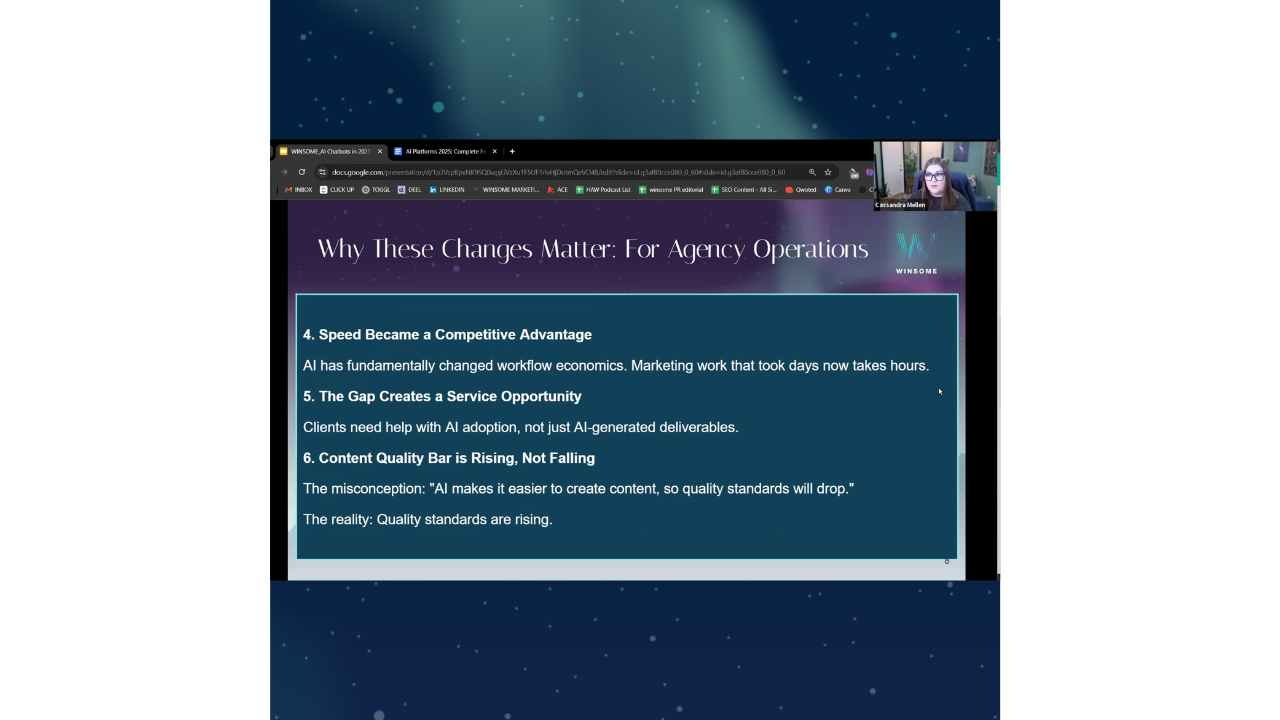
There's a misconception that AI makes it easier to create content, so quality standards will drop. The reality? They're rising.
You published an article two years ago. It ranked #3 for a valuable keyword, drove consistent traffic, generated leads. You checked yesterday—it's...