Here's the thing nobody wants to say plainly: Google didn't lose search. It lost the habit.
ChatGPT didn't beat Google in search share. It created a new behavior — a generation of users who reach for a conversation instead of a query box — and that behavior is spreading fast enough to rewrite the rules of digital visibility for every marketer, publisher, and brand alive right now.
Key Points
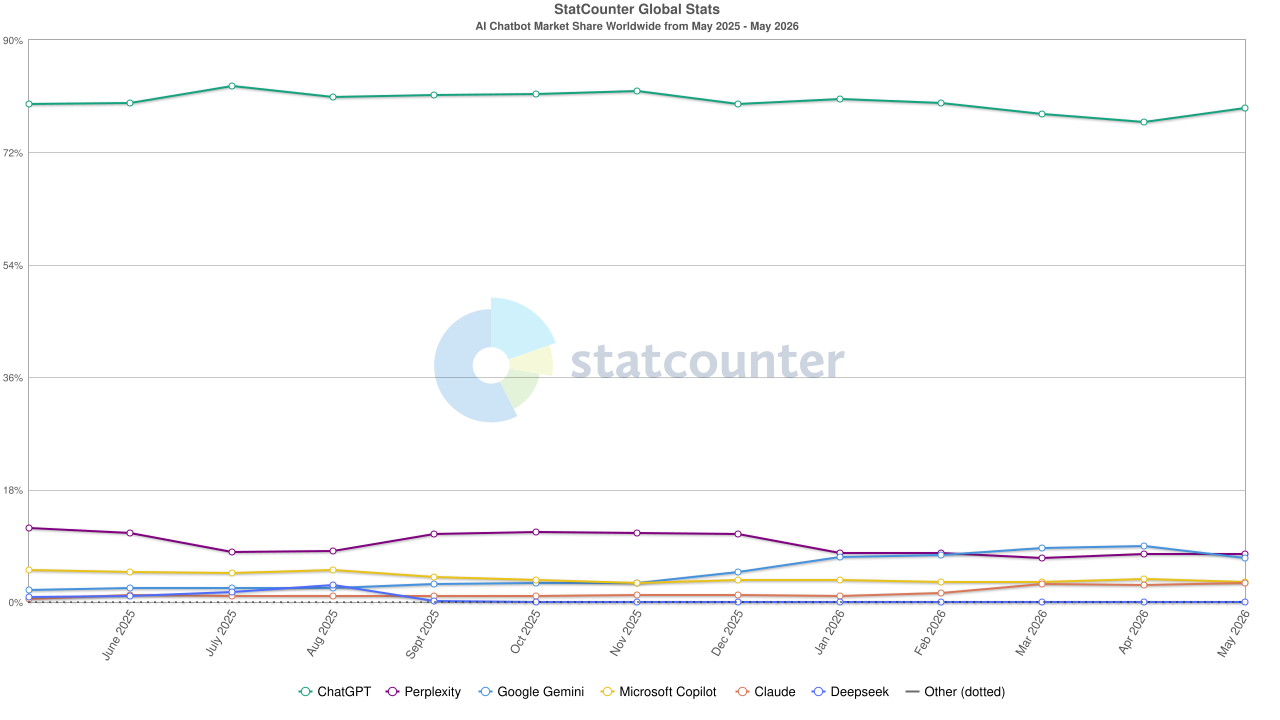
- ChatGPT dominates AI chatbot traffic: According to StatCounter's May 2026 data, ChatGPT held 79.05% of global AI chatbot market share. Perplexity came in second at 7.67%, Google Gemini third at 7.04%.
- Google still owns search overall: In the broader search engine market, Google held 90.39% of global share as of May 2026. These are two different races being run on different tracks, for now.
- The real disruption isn't answers: It's the destruction of the click. When AI gives you the answer directly, the link never gets visited. That's an existential question for anyone whose business depends on web traffic.
- Both platforms are converging: Google has AI Mode and AI Overviews. ChatGPT has Search, Atlas, and Pulse. The distinction between "AI tool" and "search engine" is dissolving faster than anyone planned for.
- Energy costs are real and asymmetric: A single ChatGPT query consumes roughly 10 to 20 times more energy than a Google search. As usage scales, that gap has environmental and cost implications that no one is talking about enough.
The Numbers Tell Two Different Stories
The StatCounter data from May 2026 is instructive precisely because it refuses to resolve neatly. ChatGPT held 79.05% of global AI chatbot market share. That's not a close race. Perplexity sits at 7.67%, Google Gemini at 7.04%, Microsoft Copilot at 3.24%, and Claude at 2.99%. In the world of AI-native chat interfaces, OpenAI's product has essentially lapped the field.

But pull back to the full search engine picture, and Google's 90.39% share makes that victory look smaller. The two numbers aren't in contradiction. They describe different user behaviors in different contexts. ChatGPT is where people go when they want to think out loud. Google is still where people go when they want to find something specific, verify a fact, buy a product, or navigate the web. One is a conversation. The other is a portal. For now, they're both winning, at different things.
The question that should keep marketers up at night isn't which platform is ahead. It's what happens when those two behaviors fully collide.
But... What Was it Made For? (only Billie Eilish Knows)
Understanding the architecture difference matters here because the strategy implications follow directly from it. Google operates on retrieval: crawl, index, rank, return links. It is extraordinarily good at finding things that exist. It indexes over a hundred billion web pages and returns results in sub-second time, surfacing images, videos, local listings, prices, and source links simultaneously. Its depth of real-time information is still unmatched.
ChatGPT operates on generation: a large language model that synthesizes a response, builds context across a conversation, and increasingly connects to real-time data through search partnerships with Microsoft Bing and media agreements with outlets including the Associated Press and Reuters. It cannot match Google's breadth of indexed content. What it can do is hold a thread, adjust its explanation to your level, help you write, debug, draft, and reason through a problem, all in the same session.
The table below captures the functional distinction that matters most for how people actually use each platform.
| What you need | Better tool |
|---|---|
| Real-time information, local results, product prices | |
| Direct answer to a specific question | Either |
| Explanation tailored to your context | ChatGPT |
| Verifiable sources and original links | |
| Writing, coding, analysis, brainstorming | ChatGPT |
| Browsing across media types (images, video, maps) |
The Click Is the Casualty
This is where the story gets uncomfortable for anyone in content marketing, SEO, or publishing. Both Google AI Overviews and ChatGPT Search are now in the business of answering the question without sending you anywhere. Google's AI Mode generates a synthesized response and surfaces source links below it, often making the click feel optional. ChatGPT's conversational format makes the link feel almost incidental.
One analysis from the Techloy comparison notes that around 72% of ChatGPT subscribers have already started using it as a primary browser on desktop and mobile. That's not a niche behavior. That's a majority of paid users reorganizing how they interact with the internet.
For marketing teams that built their pipeline on organic search traffic, this is not a distant problem. It's already affecting click-through rates on informational content. Our AI marketing strategy work at Winsome is spending more time on this question than almost any other right now: if the click disappears, what replaces it as a signal of reach and intent?
The answer involves citations. When AI answers a question, it sometimes surfaces the source. Being that source — being the brand, the article, or the expert that the AI references — is the new version of ranking on page one. It requires different content, built for different signals.
The Environmental Cost Nobody Mentions
There's a dimension to this comparison that gets skipped in most coverage because it's inconvenient. A single ChatGPT query using a model like GPT-4 consumes approximately 3 to 5 watt-hours of energy and generates roughly 4 to 6 grams of CO2 equivalent, according to analysis published on Medium drawing on Google's 2022 Environmental Report and third-party research from Stanford CRFM and MIT Technology Review. A Google search uses 0.3 to 1.0 watt-hours and emits 0.2 to 1.0 grams of CO2 equivalent.
That's a 10 to 20x energy gap per query. At the scale both platforms operate, that difference is not trivial. Google's custom TPU hardware and investment in renewable energy infrastructure gives it a structural efficiency advantage that generative AI, running on general-purpose GPUs, cannot currently match. As AI-native search scales, that cost gets distributed across data center capacity, energy grids, and ultimately pricing, which is exactly why Anthropic is walking back subsidized subscription billing and why every AI company is eventually going to have to confront what its infrastructure actually costs.
Google Is Not Standing Still
It would be a mistake to read ChatGPT's chatbot market share as evidence that Google is losing. Google's AI Mode, built on Gemini 2.5's reasoning model, delivers a conversational search experience with cited, synthesized responses and the full depth of Google's index behind it. It is, in many ways, the most complete search product that has ever existed: the speed and breadth of traditional search, combined with the synthesis of generative AI.
OpenAI has responded with ChatGPT Atlas, a macOS browser with AI-native conversational search built in, and ChatGPT Pulse, a personalized research tool that proactively pushes summaries and updates to users based on their interests. These products are moving ChatGPT from reactive to ambient: not just answering when asked, but anticipating.
Both companies are converging on the same vision. The search box becomes a conversation partner. The list of links becomes a synthesized briefing. The question is which company's version of that vision earns the most trust, and which gets embedded deepest into daily workflow.
What This Means for Marketers Right Now
The SEO playbook built for the last fifteen years assumed a specific mechanic: rank for keywords, earn clicks, convert visitors. That mechanic is not dead, but it is under serious pressure from both sides simultaneously. Google's AI summaries reduce clicks on informational queries. ChatGPT's growing search behavior pulls users away from the search box entirely.
The teams that are adapting fastest are doing three things. They're building content that is citable rather than just rankable, structured to be used as a source by AI systems, not just to place in a SERP. They're investing in brand signals that AI systems recognize, including earned media, expert authority, and direct audience relationships that don't depend on a search intermediary. And they're tracking which content categories still drive clicks and allocating budget accordingly, rather than defending the old model uniformly.
The fight between ChatGPT and Google is genuinely consequential. But for most marketing teams, the more urgent question is what either outcome means for how you reach the people you need to reach, and whether your current content strategy was built for a world that already changed.
Our growth team at Winsome Marketing is working with clients right now on exactly this: building content and AI visibility strategies for a search environment in which the answer and the click have become two different things. If your pipeline depends on organic search, it's time to understand what you're actually optimizing for in 2026.


Writing Team