

 Writing Team
The Power of What You Don't Say
 Writing Team : Feb 23, 2026 12:00:01 AM
In the frenzied pursuit of saying everything, most marketers forget the most persuasive tool in their arsenal: silence. Like the white space that...
-Feb-16-2026-09-49-52-2957-PM.png)
Most copywriters obsess over word choice while ignoring the invisible conductor orchestrating every great piece of sales copy: prosody. Like a jazz musician who knows that the space between notes creates the magic, master copywriters understand that rhythm, stress, and flow don't just make copy readable—they make it irresistible.
While your competitors are still debating whether "amazing" or "incredible" converts better, you're about to discover why Hemingway's iceberg theory applies to sales copy in ways that would make Don Draper weep with envy.
Key Takeaways:
Every piece of copy contains an invisible musical score. The difference between amateur and expert copywriters isn't vocabulary—it's conducting ability. Consider Apple's "Think Different" campaign. Grammatically incorrect, prosodically perfect. The stressed syllables land exactly where they need to create forward momentum: THINK dif-FER-ent. Three beats. Clean. Decisive.
Now contrast that with a typical SaaS headline: "Revolutionize Your Customer Relationship Management System." It's a rhythmic trainwreck—seven syllables of corporate bloat that sounds like someone reading terms of service. The prosody signals bureaucracy, not innovation.
Your copy's rhythm directly impacts cognitive processing. Short sentences demand attention. They create urgency. They force emphasis on every word. But stringing too many together creates a staccato effect that exhausts readers, like listening to someone who speaks only in bullet points at a cocktail party.
Longer sentences, when properly constructed with natural breathing points and logical stress patterns, allow readers to settle into a flow state where persuasion happens below conscious awareness—the sweet spot where prospects convince themselves while feeling like they're making rational decisions.

Master copywriters like Gary Halbert intuitively understood prosodic manipulation decades before neuroscience explained why it works. His famous coat-of-arms letter opens with: "Dear Friend, What I'm about to tell you may sound a bit strange."
Notice the rhythm: stressed syllable, pause, building tension through measured cadence. He's not just delivering information—he's creating a prosodic container that makes readers more receptive to whatever follows.
As Dr. Sonja Kotz, a neuroscientist at Maastricht University who studies rhythm and language processing, explains: "Rhythmic expectations in language activate reward pathways in the brain. When copy matches natural prosodic patterns, it literally feels good to read."
Strategic stress placement functions like a highlighter for the subconscious mind. Consider these two versions:
The second version places stress on "serious" and eliminates the rhythmic stumble of "premiums"—a word that sounds like what you're trying to avoid paying. The prosody now supports the persuasive intent instead of fighting it.
Internal rhyme and alliteration aren't just poetic flourishes—they're memory hacks. "Maybe she's born with it, maybe it's Maybelline" sticks because the prosodic pattern creates neural pathways that resist forgetting.
But like hot sauce, a little goes a long way. Overuse creates Dr. Seuss syndrome—delightful for children's books, deadly for conversion copy.
Consistent rhythm builds trust and readability. Calculated rhythm breaks create memorable moments and emotional shifts. Notice how this sentence flows smoothly until—BANG. That interruption wasn't accidental. The prosodic disruption mirrors the semantic content, creating alignment between what you're saying and how you're saying it.
The best sales letters use rhythm breaks at crucial moments: right before the offer, during objection handling, or when transitioning from problem to solution. The prosodic shift signals: "Pay attention. Something important is happening here."
Prosody isn't just about syllables—it's about pauses. White space on the page creates mental breathing room that allows complex ideas to settle. Dense paragraphs feel rushed and pushy, regardless of word choice. Proper spacing lets your copy breathe, creating the prosodic equivalent of a thoughtful pause in conversation.
Master copywriters orchestrate multiple prosodic elements simultaneously: varied sentence length for engagement, strategic stress patterns for emphasis, calculated rhythm breaks for memorability, and breathing space for processing. The result isn't just copy that converts—it's copy that feels effortless to read while being impossible to ignore.
Your prospects may not consciously notice the rhythmic sophistication, but their brains do. And in the milliseconds before logical analysis kicks in, prosody has already influenced their emotional state and receptivity to your message.
At Winsome Marketing, we analyze the prosodic patterns in your highest-converting copy to identify what's working rhythmically, then apply those insights across your entire funnel. Because when science meets salesmanship, conversion rates don't just improve—they sing.
-Feb-16-2026-09-30-28-8041-PM.png)
Writing Team : Feb 23, 2026 12:00:01 AM
In the frenzied pursuit of saying everything, most marketers forget the most persuasive tool in their arsenal: silence. Like the white space that...

Writing Team : Jan 19, 2026 8:00:01 AM
Your competitor publishes daily. You publish monthly. They rank for 500 keywords. You rank for 50. But your 50 drive more conversions than their 500....
 Cassandra Mellen : Dec 14, 2025 4:15:41 PM
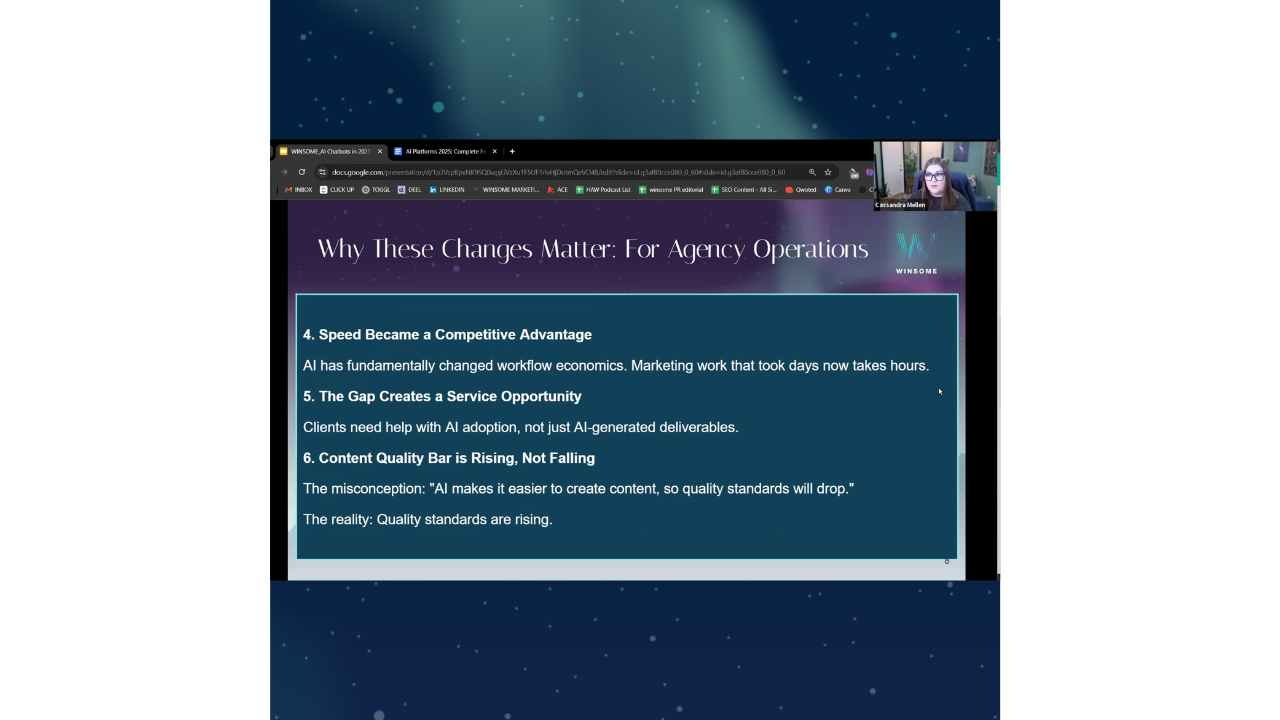
There's a misconception that AI makes it easier to create content, so quality standards will drop. The reality? They're rising.