

Marketing Nihilism: What Happens When Consumers Stop Believing in Brands
The emperor has no clothes. And everyone can see it now.
5 min read
Cassandra Mellen
:
Dec 14, 2025 4:09:22 PM
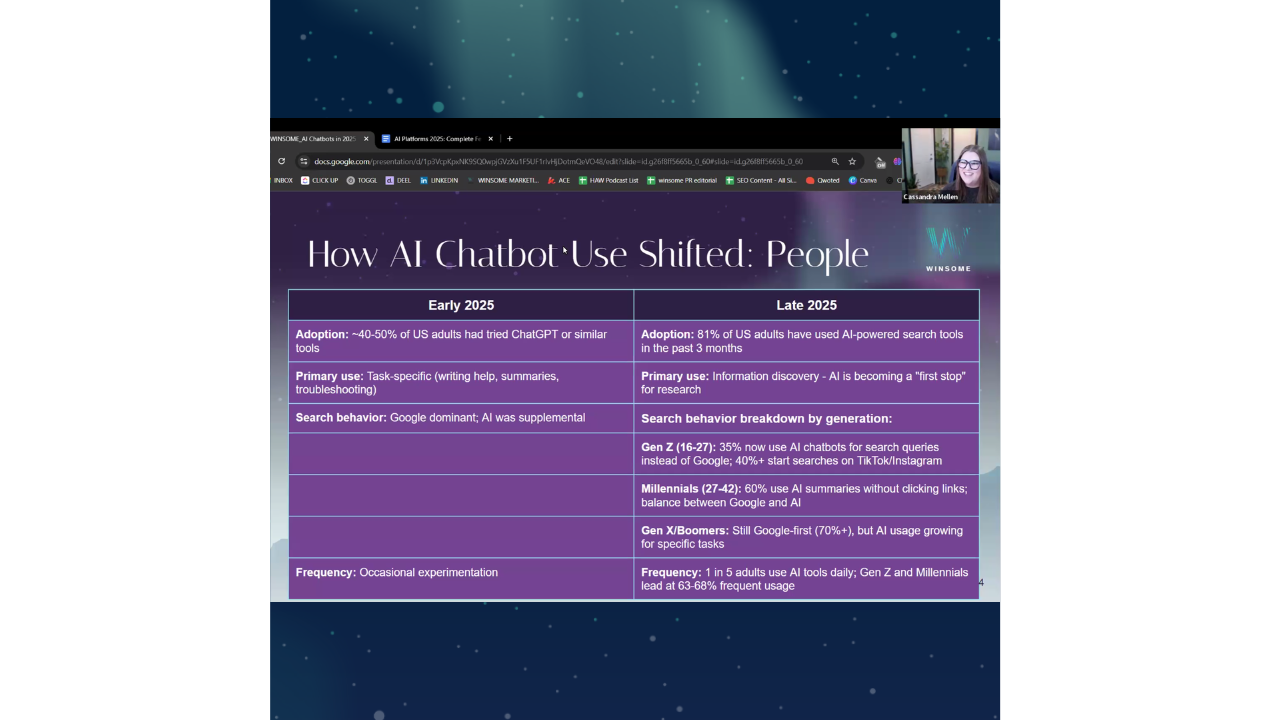
At the start of the year, 81% of U.S. adults had used AI search tools in the past three months. By now, that number has only grown. And the way people are using these tools has fundamentally changed.
In January, the primary use was basic troubleshooting, writing help, and summaries. Now, it's almost becoming a first stop shop for research and information. That shift happened fast—and most brands haven't caught up yet.
At the start of the year, Google was dominant and AI was supplemental. That's no longer true.
Gen Z is leading the change. Thirty-five percent now use AI chatbots for search queries instead of Google, and 40% of them start from TikTok and Instagram. Gen X and Boomers still Google first—70% of them—but AI usage is growing for specific tasks even in older demographics.
The frequency matters too. One in 5 adults use AI tools regularly, with the highest concentration in people 30 and under. This isn't experimental behavior anymore. It's habitual.
What this means: discovery is no longer just happening on your website. Search is fragmenting across platforms. People aren't researching the same way. Discovery is happening across Google, AI tools, TikTok, Reddit, and more. Each generation has different default platforms they go to, so when we're thinking about marketing, we have to really think about who the customer base and audiences are.
Early in the year, AI adoption was uneven. Most companies experimented with it rather than fully integrating it into their systems. They'd use chatbots for customer support maybe, and there were few AI policies or training programs in place.
That changed dramatically. According to the McKinsey State of AI report, 88% of organizations now use AI in at least one business function, up from 78% last year.
And AI is embedded everywhere now. Microsoft 365, Google Workspace, Adobe—even our phones all have AI built in. A challenge is that many employees use AI informally without training, which creates risks, especially with client information and sensitive data.
I was interested to know about the number of blogs we produced as a team in January compared to now. I feel like that would be a skyrocket, especially with how we've developed our processes and systems.
First, voice AI went mainstream. The quality of voice AI now matches or almost exceeds human phone call interactions. This isn't just about virtual assistants anymore—it's becoming a primary interface for customer service, shopping, and information gathering.
Second, agentic AI adoption surged. AI shifted from just answering questions to performing executive tasks. We're seeing AI that can complete multi-step workflows, make decisions within parameters, and handle complex processes that used to require human intervention at every stage.
Third, persistent memory and context became real. AI can maintain continuity across multiple sessions now. Claude projects can remember brand guidelines. We've connected our Claude with Slack and email so it can find documents for us. The context isn't lost when you close the window anymore.
Fourth, AI infiltrated search and discovery. This is the big one. AI answers questions directly instead of sending users to websites. That fundamentally changes visibility. Brands must be present where AI pulls its information—using a blend of public content, structured data, citations, and high-authority signals. If clients don't publish enough credible content, they'll fall out of the AI ecosystem entirely.
I thought this was interesting too: if you just go into your chat and search for your brand, or any brand, see if it pops up and how it shows up. That's something to be conscious of.
Fifth, GEO emerged as a new discipline this year. You need a strong brand footprint across authoritative sites—press mentions, citations, well-organized content so that AI can learn to read it. This isn't optional anymore.
Because of these shifts, our content needs to be discoverable by AI tools, not just Google. Brand mentions, structured data, authoritative citations—all of that matters now in ways it didn't at the start of the year.
But here's the misconception: people think AI makes it easier to create content, so quality standards will drop. The reality is they're rising. AI floods the market with mediocre content, which means standing out requires excellence. Users can spot AI-generated generic content and tune it out instantly. Search and discovery is more competitive, so only the best content gets surfaced.
What this means for marketing: brands need distinct voice and specific insights. I think we're doing this really well with some of our clients—creating content that sounds like them, not like every AI tool. Research must be deeper and more original. Human strategy and editing are more valuable than ever.
Language norms are shifting because of AI. Teams are moving away from generic AI-generated words and overused phrasing. Clients recognize them instantly, and audiences tune them out.
I think it'll be interesting to look back a few years from now just to see how people are communicating in person as well. There are words that AI uses all the time that I try to avoid now when I'm talking to somebody. Like "actually"—when AI puts that in there to sound a little bit more human, I'm like, why am I doing that?
This affects how marketers write, edit, and evaluate content. Content needs to feel distinct again. Brands want language that sounds like them, not like every AI tool. Marketers are adapting their writing habits to avoid predictable patterns. We've been doing a good job of sharing those patterns when we find something new or a way to avoid them.
Teams are relearning how to write from a strategy-first mindset instead of a fill-space mindset. People are thinking and communicating differently because AI drafts so much of their first version.
I wanted to have a moment—a little RIP for all the words that we can't really use anymore without getting side-eye, like "was that AI?"
Delve. Leverage. Navigate. Revolutionize. Landscape. Discover (in meta descriptions especially). "Picture this" as an intro. The em dash used excessively. Things coming in threes when you're describing something.
I'm sad about the em dash. I feel defiant and want to use it sometimes, but... they don't know me, you know?
These weren't bad words. They were good words. But AI overused them to the point where they signal "this was generated, not written." And once your audience spots that pattern, you've lost their trust.
For AI to read your site and your brand, you almost need to have consistent messaging across all platforms. That would be your leadership team, the website, all your social platforms. AI is grabbing information from all of that, so rather than having fragmented messaging, consistent messaging gives you a better shot of being understood correctly.
Speed became a competitive advantage this year. It's not about working less—it's about reallocating time from execution to strategy. Taking manual tasks and using that time for creative problem solving instead.
The gap is that clients need help with AI adoption—not just AI-generated deliverables. They need training, strategy, integration support. The companies that figure that out will pull ahead.
And the content quality bar is rising, not falling. Standing out requires excellence. Original research. Distinct voice. Human insight that AI can't replicate.
I think there's an underestimation of LLMs when people try to create linguistic formulas around keyword strategy or content strategy. The reality is, they're dynamic by nature. We can't account for every possible variable of who's searching, how they're searching, what conversations they've had historically. The volatility is exponential compared to what we dealt with in traditional search.
That doesn't mean we give up on strategy. It means we focus on the fundamentals that persist across all that volatility: authoritative content, consistent messaging, distinct voice, credible sources. Those things work regardless of which AI platform someone uses or how the algorithms shift.
AI chatbots changed how 81% of Americans search for information in 2025. At Winsome Marketing, we help brands build visibility across the fractured search landscape—from traditional Google to AI platforms to social discovery—with content that stands out in an AI-saturated market.
Ready to adapt to how people actually search now? Let's build a strategy that works across every platform where your audience discovers information.
The emperor has no clothes. And everyone can see it now.
"Things will go back to normal once the pandemic ends."
In an age of material abundance and digital connectivity, many consumers are facing an unexpected crisis: a profound lack of meaning. As basic needs...