4 min read

The Multi-Channel Search Reality: Why SEO Now Means Everywhere

The Multi-Channel Search Reality: Why SEO Now Means Everywhere
6:57

For the first time ever, I'm watching SEOs and industry experts talk multi-channel strategy. Before, it was always eighty-five percent website is where your search value comes from.

Multi-channel is becoming the gong everyone's hitting.

And it makes sense, because that's just the reality we're living in now. Search has fragmented. Your audience isn't all in one place anymore, searching one way, on one platform.

The Great Search Fragmentation

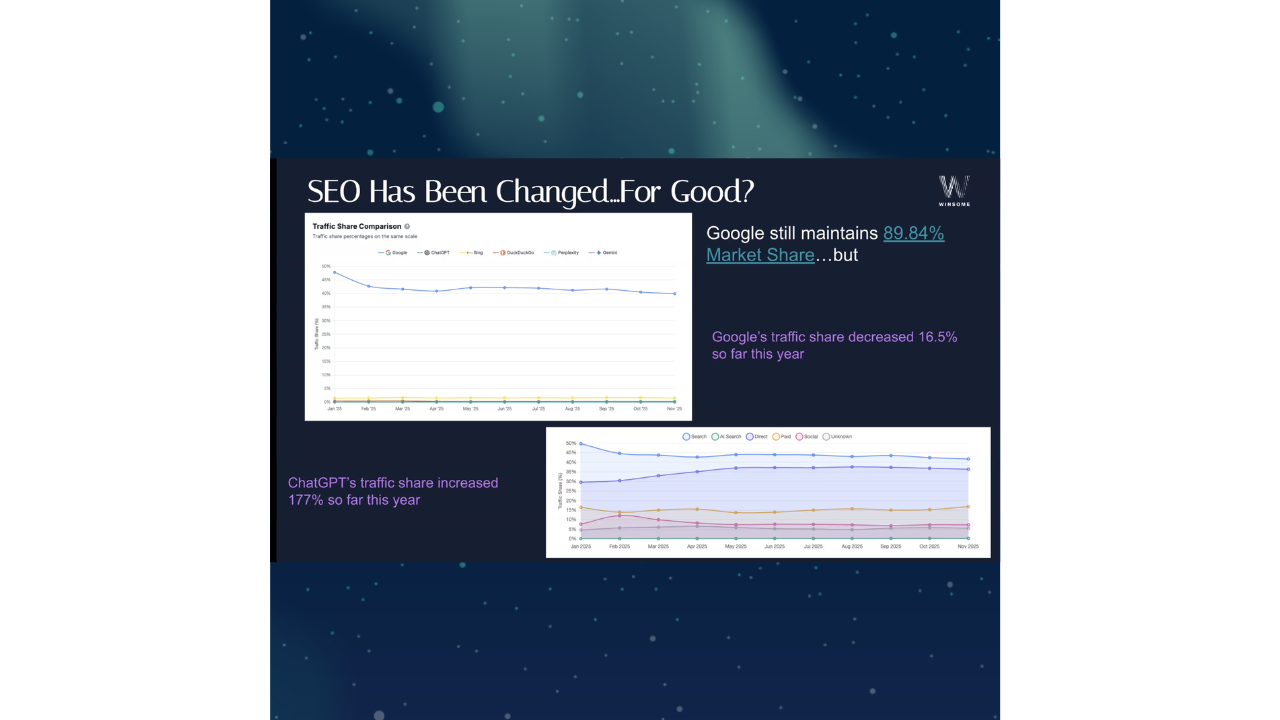
Google still has 89.84% market share. But their traffic share decreased 16.5% from January until November. That's really significant. And even though they're way above everyone else right now, if the decline continues, we're just going to see a rise in other forms of search engines or search mechanisms.

ChatGPT's traffic share has increased 177% this year. Gemini is exploding, and I think that's going to be probably the biggest one to watch going into next year. They're really poised to kind of take over, especially given how Google owns so much of the education market, the productivity software market.

But it's not just about traditional search engines and AI platforms. It's also about where people are actually searching.

The Alternative Search Engine Opportunity

A lot of people have been talking more about other organic search engines, like Bing. I've been seeing from my clients personally, Bing has contributed to a lot of organic traffic recently. Really making sure I'm updating sitemaps over there, just keeping everything as up-to-date as possible is really good.

Honestly, weirdly, for at least a couple of my clients, DuckDuckGo has been great. It's increasing. For one client it was fifteen percent month-over-month increase in DuckDuckGo sessions.

People are more educated than ever about how search works, and skeptical about what they see. That's why DuckDuckGo has increased—their entire marketing strategy is "we protect your data, everyone else sells it." That behavioral change is going to persist.

We're just seeing a shift where Google doesn't have to own everything, and in this multi-channel, multi-ecosystem that we're living in, we just have to make sure we're optimized everywhere.

New call-to-action

Social Search Is Real Search

Then there's social search. People searching on TikTok, Instagram, LinkedIn, YouTube. Not just browsing, actively searching for answers, recommendations, solutions.

What works on video is not the same throughout every platform. What's been successful for me on LinkedIn has not been successful on YouTube, and then what's been successful on YouTube has not been successful on Instagram. Because all of the people who are there, and the intent profile behind what someone is scrolling through Facebook, why someone's scrolling through YouTube, TikTok, whatever it is, is all different.

It's less about the format and more about the what people are actually doing there, and their intent behind what they're doing there.

The Death of "Own Everything"

There was that massive shift, what, five-ish, seven years ago, of "okay, we need to host everything on the website, we don't want to give any of our information to these third-party folks. I don't want to rely on Facebook for my leads. I want to do it myself, I want to build my email list, I want to own everything."

That's just not going to be possible in this multi-channel ecosystem. We're going to have to learn to play nice with these other avenues of search, because that's where our people are. That's where our customer base is.

We can't own everything.

And honestly, trying to own everything is going to leave you invisible in most of the places people are actually searching.

Where We Search, How We Search, Why We Search

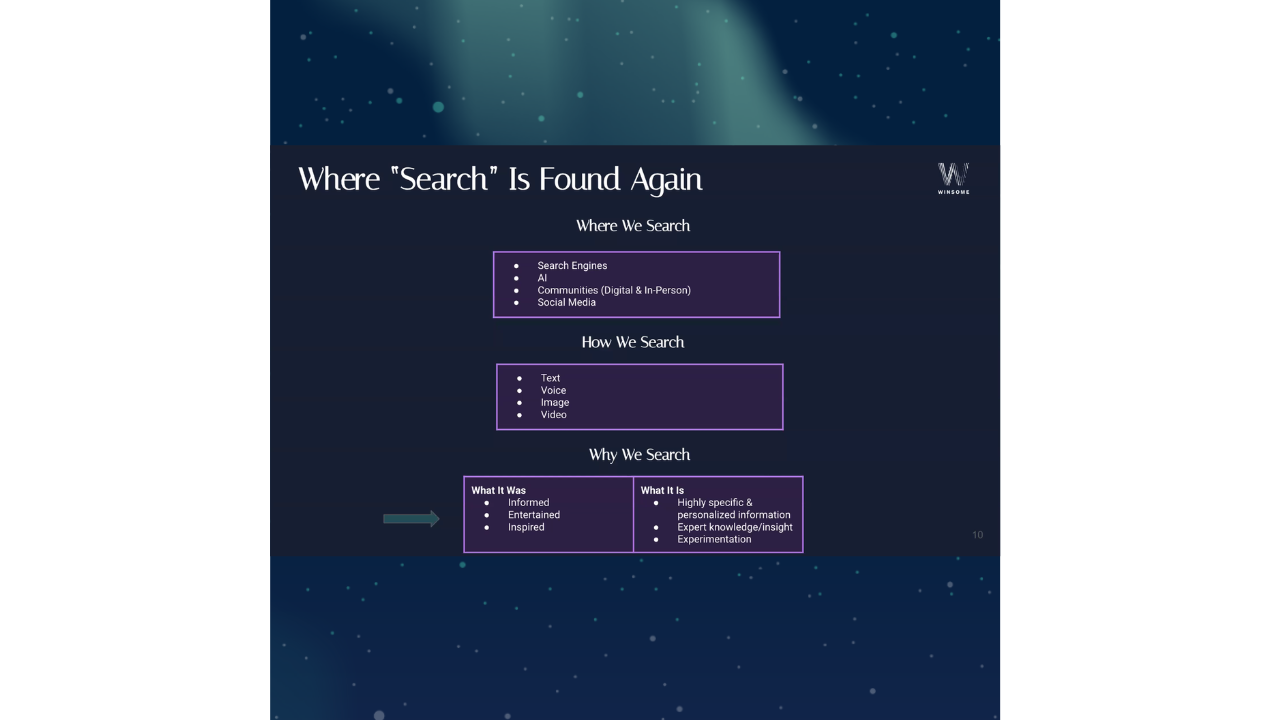
I've been thinking about this as where we search, how we search, and why we search. And it all works together.

If I know why someone is searching for something, then I'll be able to deduce probably the most likely way and how they're doing that. Is it the most likely answer that they're typing something into AI, or is it the most likely answer that they're using voice-to-text search, or are they looking for a specific product? Are they likely probably looking for different images, or are they searching for videos?

Then I'll be able to say, okay, this is the format it should be in.

And then, based on the format that it should be in, then that's where. Where is that information actually being located? Am I finding that information on social media? Am I finding it in my digital community, in my in-person community? Am I finding it in AI, or am I finding it in traditional search engines?

The Strategic Implication

This doesn't mean you need to be everywhere doing everything all at once. That's exhausting and impossible.

It means you need to understand where your audience actually searches for the problems you solve. What platforms they use. What formats they prefer. What intent they have when they're in each space.

And then you need to show up there, in the right format, with the right approach.

LinkedIn might be for thought leadership. YouTube for educational content. Traditional search for bottom-of-funnel commercial intent. AI platforms for people doing initial research. Forums for people looking for authentic peer recommendations.

Different channels, different purposes, different content strategies.

The Repurposing Reality

I still like to repurpose content. But it's not a direct repurpose. What I do is figure out a slightly different angle or hook for whatever platform I'm repurposing on, because I've seen direct one-to-one doesn't tend to work in terms of repurposing.

But if I'm intentional about it, then yes, because usually the idea permeates across platforms and communities. Everyone cares about kind of the big picture idea, it's just how they want it delivered and what hook resonates with them.

What This Means for SEO

SEO isn't just about optimizing for Google anymore. It's about understanding the entire search ecosystem your audience lives in and making sure you're findable, credible, and valuable in each relevant channel.

That's bigger than traditional SEO. That's search strategy. That's presence strategy.

And it requires thinking beyond rankings and traffic to Google properties. It requires thinking about visibility across the entire landscape of how people actually find information now.

Build Multi-Channel Search Presence That Actually Works

Search has fragmented, and single-channel strategies won't cut it anymore. At Winsome Marketing, we help you build strategic presence across every channel where your audience actually searches—not just where it's easiest to track.

Ready to show up everywhere that matters? Let's build a multi-channel search strategy that reflects how people actually find solutions.

LLMs Are Malleable: What Black Hat Tactics from 2010 Mean for AI Search

LLMs Are Malleable: What Black Hat Tactics from 2010 Mean for AI Search

LLMs are deeply malleable, and right now, they are completely susceptible to the spam tactics that kind of worked pretty well for Black Hat SEO ten...
Read More
The Three Real Reasons People Search (And Why HubSpot's Framework Is Outdated)

The Three Real Reasons People Search (And Why HubSpot's Framework Is Outdated)

I remember the foundational HubSpot framework from fifteen years ago, when they said the reasons why people search something on the internet. That...

Read More
Why AI Search Is (Currently) Impossible to Track

Why AI Search Is (Currently) Impossible to Track

We've been talking about personalization and marketing for, like, twelve thousand million trillion years. We know how important it is, and how great...

Read More