4 min read

The Three Real Reasons People Search (And Why HubSpot's Framework Is Outdated)

The Three Real Reasons People Search (And Why HubSpot's Framework Is Outdated)
6:23

I remember the foundational HubSpot framework from fifteen years ago, when they said the reasons why people search something on the internet. That was the foundation of all of the content that we would write, all of this inbound theory.

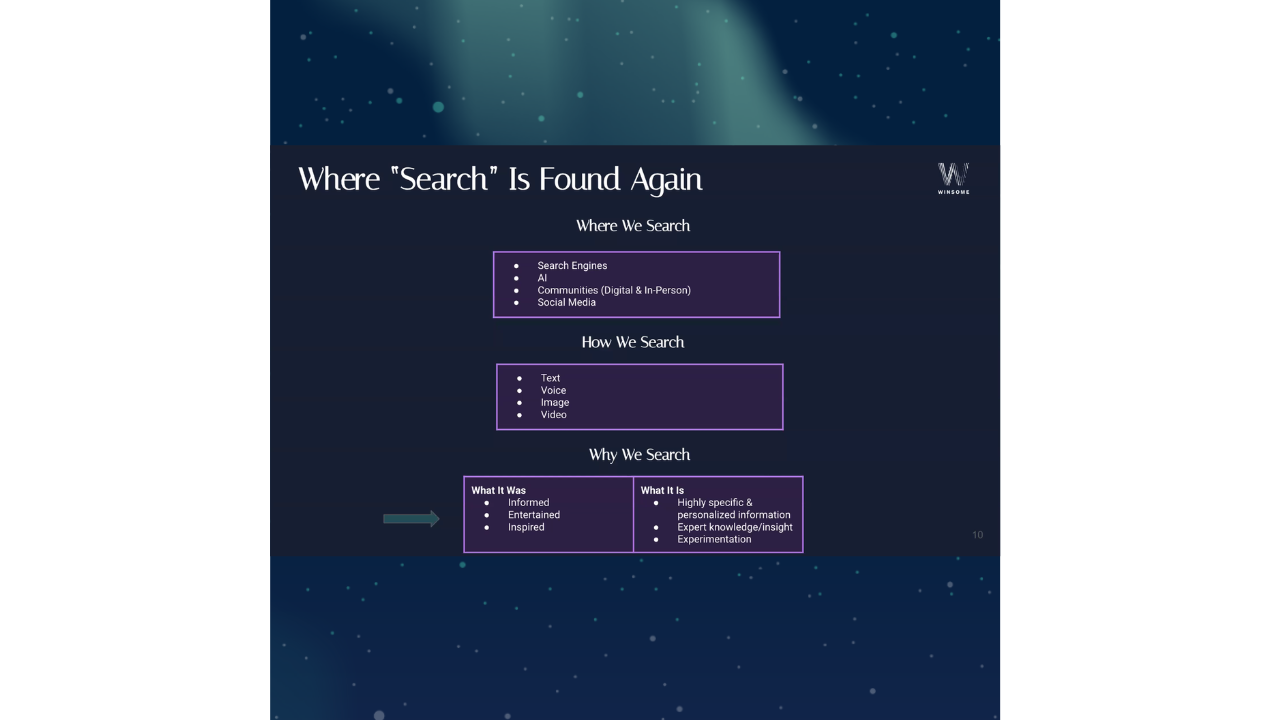
Their main reasons before, why they said people searched, was to learn something, to be educated, informed, to be entertained, and to be inspired. I remember this. I read it, recited it by heart. It was the foundation of so much of what I did so long ago.

But that's just not why people search anymore.

And I think it's so important to understand what that shift is.

What Changed About Search Intent

I was thinking about it from my perspective, why I search, why people I know search, why our clients search, why the people who I'm marketing to search.

And what I'm seeing is completely different from those three neat categories we used to rely on.

Instead of those three things that we always kind of thought it was, we're looking for really, really specific, highly, highly specific, and highly personalized information. We're looking for something that's completely tailored to our situation.

That is one of the reasons why I think AI search is so helpful, because you have super long-tail queries, you have super specific problems. If you take a kid's math problem, that's very specific to that instance, and you don't need necessarily to be educated about that. You need an answer to that question.

That's kind of how people are searching now.

Reason One: Hyper-Specific, Personalized Answers

People aren't looking for general education anymore. They're looking for the exact answer to their exact situation right now.

Not "how does email marketing work," but "how do I set up an abandoned cart email sequence in Klaviyo for a Shopify store selling subscription skincare products to women over forty."

Not "what's good SEO," but "why did my organic traffic drop thirty percent after I migrated from WordPress to Webflow last month and how do I fix it."

The specificity is the point. Generic educational content doesn't serve this intent at all.

Reason Two: Expert Knowledge and Unique Insight

People are also looking for expert knowledge and insight, unique insight and insight from people who they trust.

And I do think this is a shift, because when we look at how we would write blogs in the past, and even how we've been writing blogs the last five, seven years, we want it to be from the company, the big company perspective, the big we, and see the company as that expert.

But there's such a shift away from the company as the expert to the people who power the company as the expert.

People don't want generic best practices anymore. They want the hard-won wisdom from someone who's actually done the thing they're trying to do. They want perspective. They want insight that they couldn't get from reading ten other articles on the same topic.

They want to know what you think, specifically, based on your specific experience.

New call-to-action

Reason Three: Experimentation and Play

And then also experimentation. I think that's what AI has really been fun for, for at least a lot of people, is that you get to play around with it. You get to try something new, you get to search for new ideas, you get to try to be creative, you get to experiment, you get to play.

This intent is less about finding the "right answer" and more about exploring possibilities. What if I tried this? What would happen if I combined these two things? What are some options I haven't considered?

It's creative, exploratory, open-ended. And it's a huge part of how people use search now, especially AI search.

Why the Old Framework Doesn't Work

The problem with "educate, entertain, inspire" is that it's all about what the content does to the searcher. It's passive. It assumes people are empty vessels waiting to be filled with information or emotion.

But modern search behavior is active. People are trying to solve specific problems, make specific decisions, explore specific possibilities. They're not browsing for general knowledge. They're searching with purpose.

And that purpose is almost never "I want to be educated about this general topic."

How This Changes Content Strategy

If I know why someone is searching for something, then I will be able to deduce probably the most likely way and how they're doing that. Then I'll be able to say, okay, this is the format it should be in.

And then, based on the format that it should be in, then that's where. Where is that information actually being located?

It's a complete reversal of the old approach. Instead of starting with "what content can we create," we start with "why is someone searching for this, really?"

Then we work backwards to format and channel.

The Practical Application

For hyper-specific, personalized answers: create content that addresses very specific scenarios, not general topics. Long-tail, situation-specific, solution-oriented content.

For expert knowledge and insight: put real people forward. Write from individual perspectives. Share specific experiences, not generic best practices. Make it clear this comes from actual expertise, not content marketing theory.

For experimentation and play: create interactive content, tools, frameworks people can manipulate and apply to their own situations. Give them something to work with, not just read.

Everything Else Is Just Amplification

True expert advice is content's pot of gold. That's what's going to elevate any piece of content marketing communication that we put out.

Not generic education. Not entertainment for entertainment's sake. Not vague inspiration.

Actual answers to actual questions. Actual expertise from actual experts. Actual tools for actual exploration.

When we can tap into that why, then we actually can reverse this pyramid and make much better content strategies and marketing strategies.

Create Content People Actually Search For

Generic educational content won't cut it anymore. At Winsome Marketing, we build content strategies around what people actually search for—hyper-specific answers, expert insight, and tools for exploration—not outdated frameworks.

Ready to match real search intent? Let's build content that serves how people actually search in 2026.

Generative AI SEO: Are You Ready for it?

Generative AI SEO: Are You Ready for it?

Generative AI SEO, also known as Generative Engine Optimization (GEO), is transforming how brands optimize their online presence for AI-driven search...

Read More
GEO: Generative Engine Optimization - is Your Website Screwed?

GEO: Generative Engine Optimization - is Your Website Screwed?

Generative Engine Optimization (GEO) is the cutting-edge practice of optimizing content for AI-driven search platforms, such as Google's Search...

Read More
What is Generative SEO? Navigating the Future of AI-Driven Search

What is Generative SEO? Navigating the Future of AI-Driven Search

A new frontier has emerged that's capturing the attention of marketers, content creators, and SEO professionals alike. Generative Search Engine...

Read More